- Born: April 16, 1678 in Llanwenarth, Monmouthshire, Wales
- Immigrated: February 14, 1712 in Philadelphia, Pennsylvania
- Died: October 6, 1757 in Hilltown, Bucks County, Pennsylvania (Buried at Hilltown Baptist Church “Lower” Cemetery)
- Spouse: Ann Griffith
- Born: 1680 in Wales
- Died: 1752 in Hilltown, Bucks County, Pennsylvania (Buried at Hilltown Baptist Church “Lower” Cemetery)
- Married: 1710 in Carmarthenshire, Wales
- Occupation: Cooper, preacher
- Children: Thomas, Rev. John, Gwentlian (aka Gwently), Ephraim, Anna, Manasseh, William
There is no doubt regarding the high esteem in which William Thomas and his family were held by the people of Bucks County, Pennsylvania, where he settled upon his immigration to America from Wales.
Several pages in the History of Bucks County, edited by J. H. Battle, are dedicated to the telling of his immigration and life in Pennsylvania. Furthermore, an entire volume, The Thomas Family of Hilltown, Bucks County, Pennsylvania, by Edward Mathews, details his life and the lives of his children and grandchildren. These volumes were published in the late nineteenth century, their content drawing heavily from written records as well as the recollections of then living townspeople who knew William Thomas and his family personally.
It is thanks to these histories that so much is still known about an ancestor who was born in Wales when the United States was still thirteen colonies.
William’s Youth and Immigration
William Thomas was born in Llanwenarth, a small town on the banks of the River Usk and in the shadow of Sugarloaf Mountain, in the county of Monmouthshire in southeast Wales. At some point in his youth he moved south to a farm called Bhassaw of Mwyn in the town of Bedwellty, also in Monmouthshire. Even at the time of William’s birth in 1678, the county of Monmouthshire was one of much history. Romans and Normans settled here, and evidence of ancient Celtic civilizations has also been uncovered. British King Henry V was born in the county, and due to its situation on the English border the correct ownership of the land has been disputed by England and Wales for centuries.
William came from a landowning middle-class family and thus had the privilege of education. He learned the trade of coopering, which would be much to his advantage later in life. William was also a religious young man and demonstrated an interest in entering the ministry. He was well acquainted with Baptist Abel Morgan and possessed skills as a speaker. In 1710, when he was in his early thirties, William married Ann Griffith. Shortly thereafter, he sold a valuable patrimonial estate left to him by his parents. Virtually nothing is known about William’s parents, but it can be inferred that they died around the time of his marriage. With newfound wealth from the sale of his family estate, William decided to settle in Pennsylvania with his wife and infant son, Thomas, where his wealth and fairer laws held promise of large amounts of land and security for his growing family.
However, the family’s plans took an unfortunate turn. With their ship set to sail from Bristol to America in a few days, William and his family left all their possessions, clothing, and cash on board and departed to spend a few last days in the country. When they arrived back in Bristol before the time that their ship was set to sail, they found that it had left earlier than planned, and with all their money and possessions aboard. The ship was still in sight and they pursued it in a smaller ship, but were unable to reach it. Left penniless and with nothing but the clothes on their backs, the family agreed to a voyage on credit on the next ship bound for Philadelphia.
Upon arriving in Philadelphia on February 14th, 1712, William and his family found the ship that their possessions had been left on. The dishonest captain of the ship had sold their belongings to other passengers and William and his family had the horror of seeing other people wearing their clothes and carrying their possessions. Luckily, a family by the name of Watkins, whom William had known in Wales, paid for their voyage and gave William a loan to start his own business as a cedar cooper. William and his family moved across the Schuylkill River and settled for a time in Radnor Township in Delaware County, where he had great success in business and continued to preach occasionally as he had the opportunity. After five successful years working as a cooper, he had paid off his debts and had amassed enough money to purchase property for his growing family to settle.
Starting Fresh in America
On February 12, 1718, William purchased from Jeremiah Langhorne 440 fertile acres in Hilltown, Bucks County, on the border of Montgomery County. It was on this land that he built a stone house of one and a half stories near a natural spring of water. This home was later demolished in 1812. In 1723 he purchased another 300 acres from James Logan, who later became Chief Justice of the colony. This tract was about a mile and a half northward and did not adjoin the property on which William and his family live. Around 1740, William divided these 300 acres into two 150-acre plantations and built two stone homes for his sons Ephraim and Manasseh.
An amusing story regarding William’s first interaction with Logan has been passed down through the history books. Logan was a member of a higher social circle than William and initially looked down upon the simply clad man on horseback when asked about the price of the land. Following Logan’s rude remarks as to whether William could actually pay for the land, the Welshman is purported to have responded: “My name is William Thomas. Let me know the price of the land. If that shall meet my approbation, I will then refer thee to Mr. Langhorne for any particulars thee may wish to know concerning me” (History of Bucks County, p. 591). Logan gave the price of ninety pounds for the acreage and invited William to visit him again later. When William returned, Logan’s attitude had completely reversed. Distrusting William, Logan had indeed spoken to Langhorne, who gave such high regard to the Welshman that he vowed to pay the 90 pounds if William did not. Not surprisingly, William handed over the 90 pounds, and the 300 acres passed into his possession.
On December 28, 1725, William made a third purchase of land from fellow Welshman Rowland Ellis: one plot of 150 acres that adjoined his first 440 acres, and a non-adjoining plot of 106 acres, part of which later became home to the Hilltown Baptist church and cemetery. A fourth purchase of 212 acres was made from James Logan on April 10, 1728. A fifth and final purchase of 50 acres from Benjamin Philips was made on April 30, 1728.
By this time, William’s entire property cost him 361 pounds and totaled 1,258 acres – almost two square miles – much if not all of which had been part of William Penn’s original property. He cleared parts of this land and built 7 farm houses (believed to have been of stone), each given to one of his children upon their marriage.
The Founding of the Hilltown Baptist Church
Over three hundred years after his birth, the people of Hilltown, Pennsylvania still revere William Thomas as the forefather of their community and their church. I had the honor to visit and take a tour of the modern “upper” Hilltown Baptist Church which stands about three miles northeast of where William’s original “lower” meeting house once stood and where he, his wife, and many of his descendants are interred in the “lower” cemetery. The church members I met could not speak more highly of the man who lived hundreds of years before.
William was a fervent believer in the Baptist faith and belonged to the Baptist Church at Montgomery, several miles away from his home in Hilltown (this Montgomery church is said to have been situated along route 309 south of Colmar). He and other residents of Hilltown made the journey to Montgomery each Sunday either on foot or by wagon. However, treacherous roads and the threat of Indian raids made this long journey a perilous one.
Though William was not ordained, he was licensed by the English government to hold meetings, preach, and hold marriage ceremonies. Around the year 1725, William began holding meetings and preaching in order to make Sunday worship more accessible to his fellow Hilltown residents. These first meetings were likely held in his and other residents’ homes, or outdoors in the warmer months. Additionally, William assisted the Rev. Benjamin Griffith in preaching at the Montgomery church and became known as “Elder” William (“Elder” meaning the same as “Reverend” in the Welsh tradition at the time), even though he was not ordained.
Because William was wealthier and owned more land than most of the other residents of Hilltown, he was able and willing to donate land for the construction of a meetinghouse. He set aside 4 acres on the west corner of his 106-acre tract from Ellis, set between a forest and a spring along the Bethlehem turnpike. The first meetinghouse was built in 1737, when William was 59 years of age, and was constructed of either stone or logs. It is said that William finished the interior of the building himself and constructed a pulpit from a hollow gum tree.

(from “A Walk Down Memory Lane” p. 25)
Even without the need to travel to worship every Sunday, the threat of Indian attacks was still a reality. It was the eve of the French and Indian War, and nearby Berks and Northampton Counties had been devastated by Indian attacks. Legend says that parishioners at the Hilltown meetinghouse went to the church armed with guns, stacked at the door upon entry, to defend themselves in the case of an attack. William also supposedly knew military tactics and is said to have propped his gun against his pulpit while preaching.
Though William was licensed to preach, he was not able to lead communion, and so the residents of Hilltown still made the long and dangerous journey to Montgomery whenever communion was held there. To lessen the need for travel and accommodate a rapidly growing town and congregation, an “upper” meetinghouse was built in 1756 on land given by John Kelly, three miles northeast of the original “lower” meetinghouse.
It is unknown if Elder William preached as this second meetinghouse. By this time, William was well into his seventies, and his son John, ordained in 1751, was preaching in his father’s stead more and more often.
William’s Character and Physical Appearance
Tradition says that William was short, thickset, yet able-bodied and bony rather than fleshy. It is said that he had dark hair, eyes, and complexion and was sharp spoken in speech. William was very strict in his beliefs and teachings and possessed a strong and vigorous mind.
There is also a legend that in his old age William showed the ability to foretell the future. It is said that shortly before his death, William accurately described the futures of each of his seven children.
At the time, his daughter, Anna, was sick. He came to her one night and said that she would recover and be pursued by and marry one Stephen Rowland (whom she supposedly did not know at the time), but that she would die a year later in childbirth. It is not known if Anna died in childbirth, but she did indeed marry Stephen Rowland and die childless shortly thereafter.
William also proclaimed that all his sons would be good Christian men, and that one would be a preacher. However, he said that one of his sons would stray from the church and die at a young age by violence. True enough, William’s son John became an ordained minister in 1751, and his youngest son, also named William, was murdered under suspicious circumstances.
Sadly, almost nothing is known about William’s wife, Ann.

William’s Will and Final Years
William lived to be 79 years of age, having spent over 40 of those years building a prosperous life and community in America. In his will, written by Rev. Griffith on Dec. 11, 1753, he left land to each of his children:
- To his daughter Gwentlian Morris, 100 acres adjoining the meeting house, to pass in ownership to her oldest son, Cadwallader, after her death.
- To his son Ephraim, 150 acres from his tract of 300 acres acquired from Logan.
- To his son Manasseh, the other 150 acres from Logan
- To his son John, the land that John lived on: 200 acres acquired from Logan, adjoining Ephraim and Manasseh’s land.
- To his oldest son, Thomas, 50 acres acquired from Phillips, 50 acres bordering Anna’s land, acquired from Langhorne (known as “the long field”), as well as the 150 acres acquired from Ellis that Thomas lived on.
- To his daughter Anna, 100 acres acquired from Langhorne, to pass into her brother William’s possession after her death.
- To his son William, the remainder of the land acquired from Langhorne, where Elder William then lived.
It may be noted that, in the case of his two daughters, William ensured that the land would pass to their sons or brothers in the event of their death, not to their husbands, thus ensuring that the property would stay within the family’s bloodline.
Strict in his beliefs and teachings, William was also strict about the future of his meetinghouse. He detailed his wishes for its future in his will, stating:
“I give and bequeath unto the inhabitants of Hilltown, forever, the meetinghouse erected by myself, together with the graveyard in which to bury their dead, and all others, far and near, black and white”
(The Thomas Family of Hilltown, p. 15)
The will further forbids the burial of anyone guilty of “self-murder” in the graveyard, while permitting its expansion on a specified lot as necessary. He forbade the cutting of any timber on the church’s land, except for the repair of the church building. He permitted the land to be used for the schooling of children both from the community and from elsewhere, and for Christian worship. He requested that the Baptists hold meetings there as often as possible, but strictly forbade its use by Moravians or Catholics, or anyone who deny the Nicene Creed or refuse allegiance to a Protestant king.
Large horizontal stones in the lower cemetery mark the final resting places of William and his wife, Ann. William’s gravestone bears an epitaph that he likely penned, himself:

“In yonder meeting-house I spent my breath,
Now silent, mouldering here, I lie in death;
These silent lips shall wake, and yet declare
A dread amen to truths they published there”
The Legacy of the Hilltown Baptist Church
At the time of William’s death in 1757, Hilltown had two Baptist churches: the “lower” meetinghouse given by William, and the “upper” meetinghouse three miles north. In 1771, William’s original meetinghouse was demolished and replaced.
On November 25, 1781, the two meetinghouses became collectively incorporated as the Independent Baptist Church at Hilltown. At the time, the church had 54 members, most relatives and of Welsh, Irish-English, and German origin. Within just two years of incorporation, the church had grown to 94 members. Hilltown was now the largest church in the Philadelphia Baptist Association. John Thomas, William’s son, was the first official pastor of the Hilltown Baptist Church, with services held at both the upper and lower houses on alternating Sundays. John was also the pastor at Montgomery following Rev. Griffith’s death in 1757. John served as pastor until 1789, when Moses Aaron took over as the pastor of Hilltown.
The upper and lower meetinghouse sites have each had four church buildings. The second lower meetinghouse built in 1771 lasted until 1846, when it was also demolished and replaced by a brick structure. This brick structure was again replaced in 1890. The upper meetinghouse built in 1756 was replaced in 1803 and again in 1884. The 1884 chapel still stands and has since been expanded to include Sunday school classrooms, offices, and a large worship space. A cemetery also adjoins the upper meetinghouse, now simply known as the Hilltown Baptist Church.


Although William had given the lower meetinghouse to the People of Hilltown (and not necessarily the congregation of the upper meetinghouse), the congregation of the two meetinghouses was essentially the same since the time that John Thomas was pastor. It fell upon one congregation to support 2 churches financially. Around 1930, the congregation discontinued the use of the lower meetinghouse for regular services, though the building was used for funerals and family reunions until the mid 1950s.


In the 1960s a committee was formed with the task of saving the building. However, vandalism and disrepair had reduced the building significantly from its splendor at the turn of the 20th century. Legal actions gave Hilltown Baptist Church permission to take whatever action necessary on the building, and the building was ultimately demolished in 1970. At the time, it was believed to be the oldest Baptist church building in Bucks County and one of the oldest in Pennsylvania.
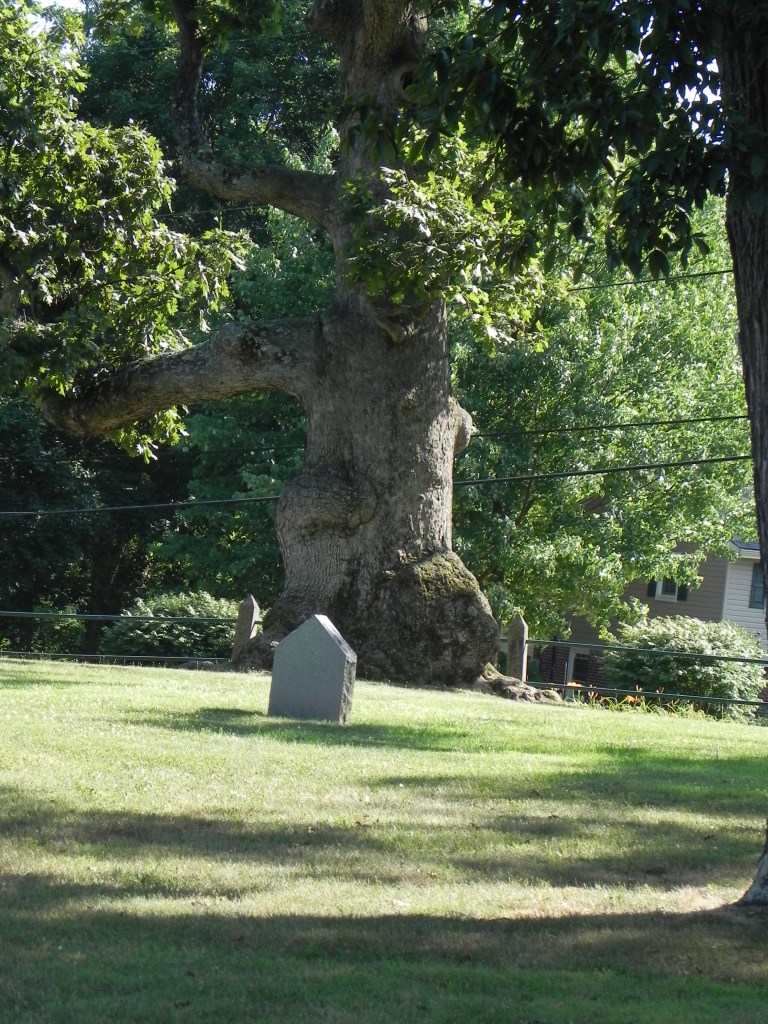
The property where the lower meetinghouses once stood is now marked with a stone. Along the road stands an enormous oak tree, christened a “Penn Oak” because it stood when William Penn came to an agreement with the local Indians in 1682. In 1932, the tree was believed to be 250 years old, and in 1982 its diameter measured 15 feet, 14 inches.
The large cemetery of the lower meetinghouse also remains, partially surrounded and shaded by trees, itself a testament to the centuries that have passed since William first set aside this land for the church. The oldest gravestones are made of plain shale or have been lost to the passing of time and the elements. It is believed that some graves are of Indians, as tradition says that some were friendly and would visit the cemetery to honor their ancestors.
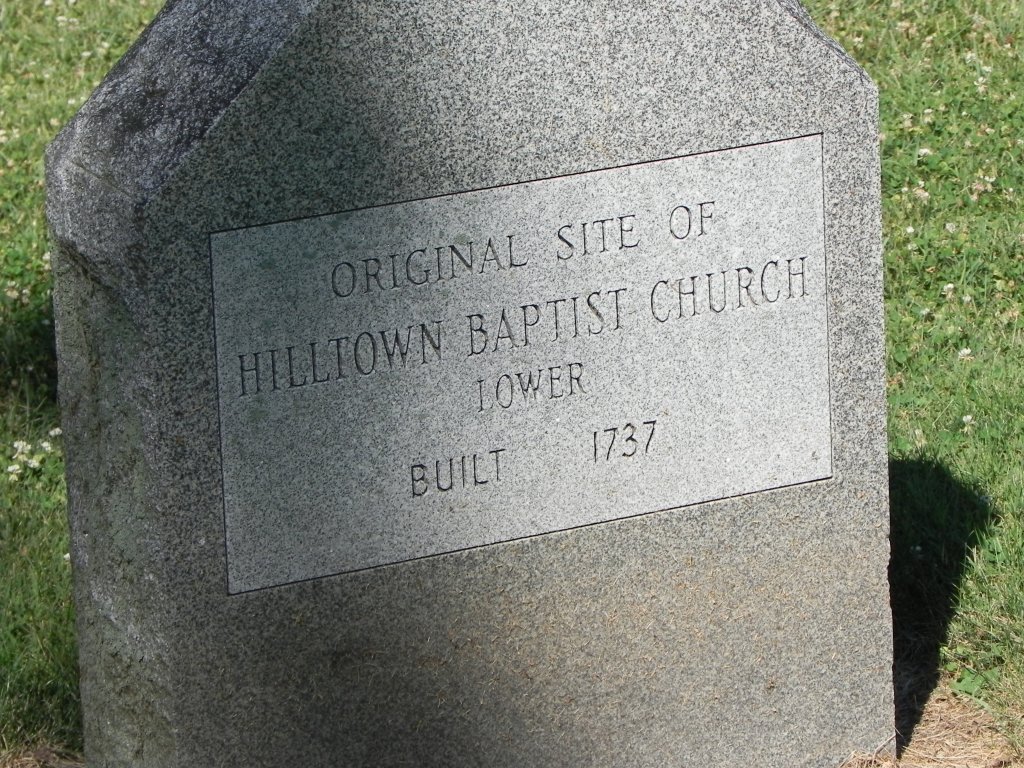
This lower cemetery is the final resting place of William, his wife Ann, all seven of their children, and all their grandsons. Including William and his son, John, five Hilltown ministers and their wives are buried here. There are also graves of 22 soldiers, 15 of whom fought in the American Revolution. It is known that one soldier’s grave is unmarked. The cemetery is the final resting place of Benjamin Morris, a clockmaker and Bucks County sheriff, and Mathias Morris, who was a member of Congress in 1839. Also buried here is John Pugh, who was the recorder of deeds for Bucks County, served on the state legislature from 1800-1804, served in Congress from 1804-1808, was also a Justice of Peace. Some people have nine sets of grandparents in this one cemetery.
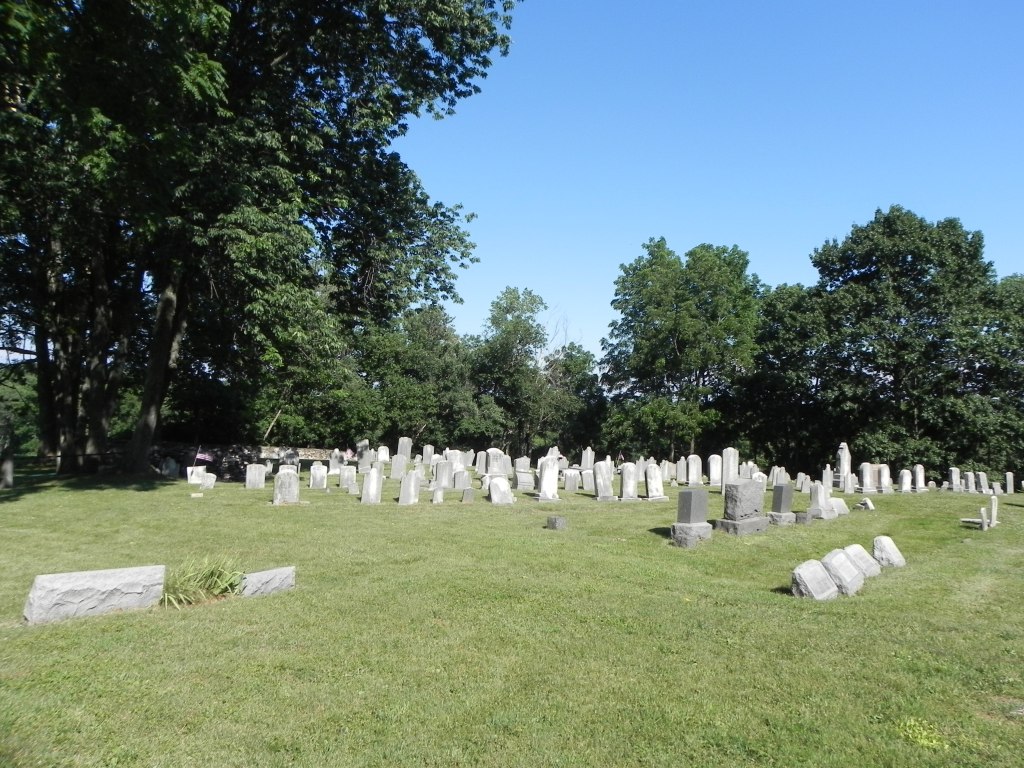
A stone wall was built around the lower cemetery between 1812 and 1830. Though some stones were removed to make the foundation for the parsonage in 1895 (standing at the corner of Hilltown Pike and Chalfont Road), the wall remains.

Children of William and Ann Thomas:
William and Ann Thomas had seven children.
Thomas, their eldest son, is discussed here.
John was born in December 1713, the first of William and Ann’s children born in America while his parents were still residing in Radnor. He married Sarah James, with whom he had four daughters: Anna, Rebecca, Leah, and Sarah. John was ordained in 1751 and gradually began taking over his father’s role as preacher at the lower meetinghouse, while also serving as pastor at the newly built upper meetinghouse. Upon the incorporation of the Hilltown Baptist Church in 1781, John became its first official pastor. John retired in 1789 after a stroke left him paralyzed, and he died on October 31, 1790. His wife, Sarah, died on April 2, 1805, having lived to be 94 years of age. Both are buried at the Hilltown Baptist lower cemetery.


Gwentlian was born in 1716. Her father preferred to call her “Gwently.” She married Morris Morris, son of Cadwallader Morris from Wales, and had nine children: Cadwallader, Abraham, William, Benjamin, Enoch, Joseph, Morris, and two others who died very young. Gwentlian died in April 1785. She is buried at the Hilltown Baptist lower cemetery.
Ephraim was born in 1719. He was a ruling elder of the Baptist church at Montgomery, and it is said that he had great abilities to console those who were grieving. He married Eleanor Bates in 1740 and they had eleven children: Enoch (who died young), Margaret, Elias, Dinah, Enoch, Rachel, Sarah, Elinor, Joseph, Ephraim, and John. Ephraim is said to have been, like the rest of his family, short and stocky with dark hair and eyes. He died on July 31, 1776, at the age of 57 – quite young when compared to his father and most of his brothers. This was attributed to his affliction by dyspepsia (chronic indigestion). Likewise, several of his children were weak and died young of illness. It has been noted that his daughters were very lively and bright, but often sickly.
Anna was born around 1719 – most likely late 1719 or early 1720 – and lived with her father until his death. She married Stephen Rowland (born in Wales in 1722) in August 1757 but died less than two years later on May 14, 1759, as was foretold by her father. She is buried in the Hilltown Baptist lower cemetery.

Manasseh was born in 1721 and Married Elizabeth Evans around 1750. They had three children: Eber, Amy, and Alice. Manasseh served in the American army in the Revolution, and it is said that he buried jars of money on his property to protect them from any British raids. In The Thomas Family of Hilltown, a story is recounted in which a Hilltown resident saw what he believed to be Manasseh’s ghost looking around behind the house he owned in life. The man who saw the apparition presumed that Manasseh was still guarding his buried treasure 100 years after his death, even though the jars had long since been recovered. Manasseh died on February 7, 1802 and is buried in the Hilltown Baptist lower cemetery.
William, the youngest of William and Ann’s children, was born in 1723. William Jr. married Abigail Day around 1750, and they had three children: William, Joseph, and Martha. Abigail was the only daughter of Joseph Day. It is said that as a child she was “evil and wayward” and that after her marriage to William she would attract “admiration and attention from other persons than was credible to a married woman” (The Thomas Family of Hilltown, p. 50). Sadly, William Jr. fulfilled his father’s prophecy that one of his sons would take to “intemperate ways” and meet a violent, premature death. The circumstances surrounding William Jr.’s death in July, 1764, are detailed in The Thomas Family of Hilltown:
“He was found dead one morning within the doorway of his house with a dark streak around his neck, as though strangled. The night had been dark and he had been away from home, drinking. It was strongly hinted and suspected that his death happened through foul means. An investigation took place. His wife was accused of the deed, or as being accessory, and tradition says she stood her trial at Newtown, but was acquitted for want of sufficient evidence”
(p. 50)
Since William Jr. had been willed the house that his father built and lived in, it can be presumed that this violent act took place at the oldest family homestead, built by Elder William almost 50 years before. William Jr. was buried in the Hilltown Baptist lower cemetery with his parents, brothers, and sisters. As for Abigail, she later remarried Philip Bitting, a German, with whom she had a family. Later in life she joined the Hilltown church and was buried in the Hilltown Baptist lower cemetery following her death in 1811. However, never satisfied with her acquittal, the Reverend Mathias who was the pastor at the time refused to officiate at her funeral or grave site.
 Leaves on the Tree