Figuring that my DNA is probably the least likely of personal information to be stolen and used against me, I downloaded the raw data from ancestry and uploaded it to “MyTrueAncestry” to see what ancient results it might generate. Without paying, I can’t get a ton of info, but the site does promise quite interesting looks into the cultures and lives of peoples of millennia ago.
To scratch the surface, here’s my ancient breakdown:
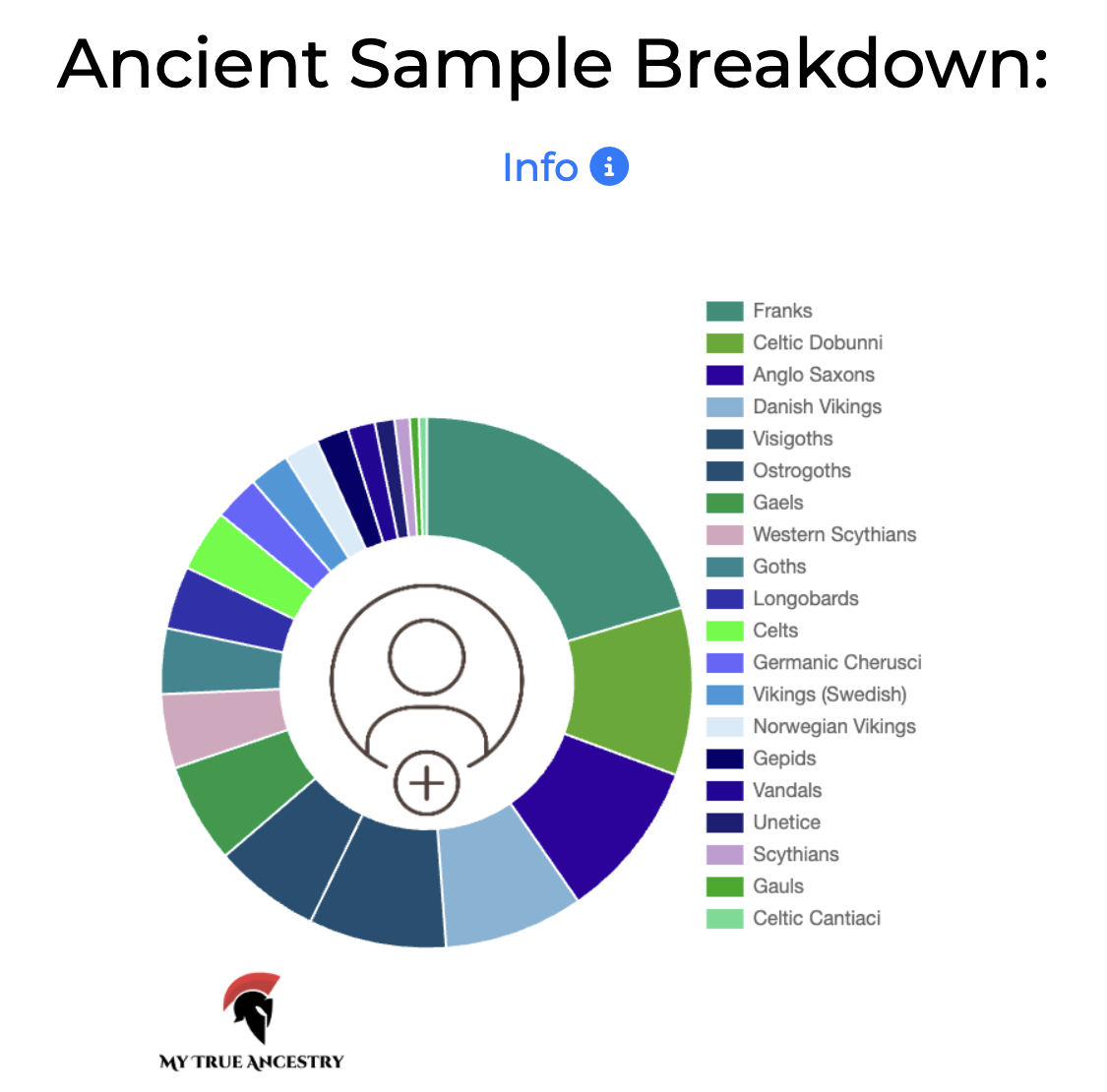
Franks (20.4%)
Francia, also known as the Kingdom of the Franks was the largest post-Roman barbarian kingdom in Western Europe. It is the predecessor of the modern states of France and Germany. Francia was among the last surviving Germanic kingdoms from the Migration Period era before its partition in 843. The core Frankish territories inside the former Western Roman Empire were close to the Rhine and Maas rivers in the north. After a period where small kingdoms inter-acted with the remaining Gallo-Roman institutions to their south, a single kingdom uniting them was founded by Clovis I who was crowned King of the Franks in 496. The geography of the Frankish realm varied over time, but a basic split between eastern and western domains persisted. The eastern kingdom Austrasia centered on the Rhine and Meuese and expanded eastwards into central Europe. The western kingdom Neustria was founded in Northern Roman Gaul. In Germany there are prominent places nameed after the Franks such as the region of Franconia (Frankfurt) and Frankenstein Castle.
Celtic Dobunni (10.2%)
The Dobunni were a Celtic tribe based in central Britain whose capital was located in Cirencester, the largest town in the Cotswolds. They were primarily farmers and craftsmen living in small villages in fertile valleys. Roman historian Dio Cassius first mentions them by name and they were described as a non-warlike tribe who easily capitulated to the Romans and easily adopted a Romano-British lifestyle. Their goddess was named Cuda, associated with the Cotswold Hills and its rivers and springs. They were also known to be one of the local tribes who issued coins before the Roman arrival.
Anglo Saxons (9.69%)
In the darkest days of the Roman Empire, a barbarian horde rose with villages stretching across the North Sea terrorizing both sides of the English Channel. The Saxons were warrior kings who lived for glory and gold. It is said in the 5th century, the British Warlord Vortigern sought help to fight the Picts and the Scots. The Saxon mercenaries led by Hengest and Horsa arrived on the scene. When they were not paid they began to invade the entire island, especially with flooding and coastal changes washing away their homeland forcing mass migrations. The southern coast kingdoms of Essex, Wessex and Sussex were settled by the Saxons. The Angles settled the eastern coast and the midlands including the kingdoms of Anglia and Mercia. The Jutes settled Kent and the Isle of Wight. All these germanic tribes were pagans worshipping Tiw, Woden and Thunor very much like their Viking neighbors with Tyr Odin and Thor. Ultimately, King Aethelbert of Kent converted to Christianity and became the Overlord of Britain. Raedwald of Anglia later took over and continued to spread Christianity around Britain which helped unite the Britons with the Anglo-Saxon invaders.
Danish Vikings (8.47%)
Angul and Danum were sons of the all seeing god Heimdall. Angul became father of the Angles who conquered the Frisii and the Roman province of Britannia, Danum would become the father of the Dani in Scania. Soon everyone would know this as the land of the Danes or Denmark (named after its marshland border with the Franks). Masters of the sea, they would raid small villages on the Frankish coast to start with, but as money and slaves flowed in, they became more ambitious. Danish Vikings eventually became conquerors and settled the Danelaw in Britain. This is where the laws of the Danes held sway and dominated those of the Anglo-Saxons. In the 10th century the kingdom of Denmark coalesced in Jutland under King Gorm the Old. His son Harald Bluetooth conquered Norway, unified Denmark, and Christianized the Danes. These accomplishments are inscribed in runic on a huge gravestone at Jelling. His son Sweyn Forkbeard raided England anually and was accepted as king of that country. His son Cnut the Great reconquered Norway and forged an Anglo-Danish kingdom that lasted until his death in 1035.
Visigoths (8.36%)
The Visigoths emerged from earlier Germanic Gothic groups (possibly the Thervingi) who had invaded the Roman Empire beginning in 376 and had defeated the Romans at the Battle of Adrianople in 378. Relations between the Romans and the Visigoths were variable, alternately warring with one another and making treaties when convenient. The Visigoths invaded Italy under Alaric I and sacked Rome in 410. After the Visigoths sacked Rome, they began settling down, first in southern Gaul and eventually in Hispania, where they founded the Visigothic Kingdom and maintained a presence from the 5th to the 8th centuries AD.
In or around 589, the Visigoths under Reccared I converted from Arianism to Nicene Christianity, gradually adopting the culture of their Hispano-Roman subjects. Their legal code, the Visigothic Code (completed in 654) abolished the longstanding practice of applying different laws for Romans and Visigoths. Once legal distinctions were no longer being made between Romani and Gothi, they became known collectively as Hispani.
Ostrogoths (6.48%)
Originating from Scandinavia, the Goths of Eastern Europe were shattered when Attila and the Huns blasted onto the scene. The Gothic kingdom was split – those who crossed the Danube to enter the Roman Empire became the Visigoths. The Ostrogoths who remained in Dacia to face the Huns became their vassals. They migrated into the Roman province of Pannonia (modern day Hungary, Austria and Croatia) and fought with their Hunnic overlords against the Romans, Visigoths and their allies. When the Hunnic empire was defeated, the newly independent Ostrogoths remained in Pannonia. When the western Roman empire collapsed to the warlord Odoacer, the Byzantines looked to the Ostrogoth King Theodoric to reclaim Italy in 488 AD. After liberating Italy, the Byzantines treated Theodoric as an equal. Under Theodoric’s rule, Italy flourished and Roman laws and customs continued under Ostrogothic rule, becoming the strongest in western Europe. In 535 AD after Theodoric’s death, the Gothic war with Byzantium began and Emperor Justinian won ending the Ostrogothic kingdom.
Gaels (6.08%)
The Gaels are a group native to Ireland, Scotland and the Isle of Man who are associated with the Gaelic language which originated in Ireland. When the Romans arrived to Britain, the Gaels traded with them. During the Middle Ages, Gaelic culture became dominant in parts of Scotland and the Isle of Man with even some Gaelic settlements in Wales. Gaelic Ireland was made up of several kingdoms with a High King claiming lordship over them. Traditional Gaelic society is organised into clans with a king or chief elected through tanistry. Pre-Christian Irish were pagans who worshipped the Tuatha De Danann and believed in an Otherworld. Their four yearly festivals of Samhain, Imoic, Beltane and Lughnasa continue to be celebrated even today. In the 12th century, Anglo-Normans conquered much of Ireland and even Normanized parts of Scotland. However Gaelic culture remained especially strong in the west of Ireland and the Scottish Highlands. Furthermore the rich Irish mythology was preserved and recorded by medieval Irish monasteries.
Western Scythians (4.51%)
The Western Scythians, a nomadic group flourishing around 300 BC, were renowned for their exceptional equestrian skills, roaming the vast steppes of the Great Hungarian Plain with unparalleled agility and grace. These fierce warriors, adorned in vibrant and intricate clothing, were feared and respected for their mastery in archery, their arrows often deciding the fates of battles. The women of the Western Scythians stood out as embodiments of strength and independence, many skilled in horseback riding and combat, challenging the gender norms of the ancient world. Their society was rich in artistic expression, evidenced by their ornate gold jewelry and elaborate animal-style art, which reflected their deep connection with the natural world and spiritual beliefs. Living in a harsh, unforgiving landscape, the Western Scythians developed a resilient culture, leaving a legacy of formidable warriors and skilled artisans that continue to fascinate historians and enthusiasts alike.
Goths (3.98%)
The Goths were a Germanic tribe whose origins stemmed from the island of Scandza in Scandinavia. Over the years they slowly migrated southwards eventually to the Black Sea and into the Roman Empire. They had a written language with Runic inscriptions. It is said they worshipped the god of war and would hang human arms from trees and perform human sacrifices of prisoners. In 395 AD, the Gothic leader Alaric rose to power and had a plan to seize good farmland and monetary rewards from Romans. He became an outlaw of both the Western and Eastern Roman Empires and eventually there was a massacre of Gothic settlers near Constantinople in 400 AD. Sensing weakness with the Western half, Alaric found supporters with other outlaws of Rome – as well as runaway slaves. He camped an army outside Rome and sacked the city in August 410 AD. In the 5th century the Gothic tribes had split clearly into two Kingdoms built on the ruins of the former Western Roman Empire. The Visigoths ruled in Iberia and the Ostrogoths ruled over Italy.
Longobards (3.83%)
The Longobards (Winnili) were a pre-Viking era Scandinavian tribe who migrated south towards Germania. Upon reaching Germania, the Winnili ran into conflict with the powerful Germanic Vandals. Both sides appealed to their chief god Odin for victory. To achieve victory against the more numerous Vandals, the godess Freia told the Winnili women to tie their hair to look like beards. Odin saw them standing in the field and asked who are these long beard warriors? After their victory the Winnili were called the Longbeards which in time renamed to Longobards/Lombards. Not finding adequate food resources, they ventured into Pannonia in modern day Hungary. There the Longobards allied with the Avars to defeat the Gepids, but all the spoils went to the Avars. As a result, the Longobards under King Alboin left the region and relocated into northern Italy where the land was ripe and by then the Longobards had a fierce reputation. The Byzantine Empire had spent vast amounts of money defeating the Ostrogoths and now had the Longobards to deal with. Eventually the Longobard Kingdom of Italy was split between two rulers, one at Milan and the other at Pavia. Weakened by internal fighting, Charlemagne of the Franks seized the lands of the Longobards and absorbed it into the kingdom of the Franks. However, some territories survived under Lombard dukes.
Celts (3.75%)
The ancient Celts were various population groups and tribes living in mainland Europe from the Late Bronze Age onwards. Tribes included the Gauls, Helvetii, Scordisci, Serdi, Boli and Iceni among others. Wherever Celts settled, they spoke related languages and maintained the same artistic traditions. Celtic warriors were known for long hair and imposing physique. By serving as mercenaries for Carthage against Rome, the Celts gained a reputation for being fierce warriors and skilled horsemen who fielded chariots into battle. Celts used musical instruments called carnyces which were used to frighten the enemy before combat. Greek art depicts their distinctive long shields and long swords. Among insular Celts, women could take a warrior role – Boudica was the queen of the Iceni tribe who formed a rebellion against Roman occupation of Britain.
Celtic art can combine geometric decoration with figurative subjects in a extremely stylised manner.
Germanic Cherusci (2.76%)
The Cherusci inhabited parts of the plains and forests of northwestern Germany in the area of the Weser River and present-day Hannover. Famous chieftain Arminius led the Germanic tribes to victory at the Battle of the Teutoburg Forest in 9 AD – destroying 3 entire Roman legions under command of Publius Quinctilius Varus in what is considered one of Romes greatest defeats. This prevented Romanization of Germanic peoples east of the Rhine and was a turning point in history – Germanic peoples would fight Rome for 700 years. Arminius was taken by the Romans as a child, taught latin and Romanized. Despite his Roman upbringing and member of the Equite class, he was not able to turn a blind eye to the suffering of his people. Eventually the Germanic Chatti tribe conquered the Cherusci in 88 AD and the Cherusci began to disappear from records as they were absorbed into later Germanic populations such as the Saxons, Thuringians, Franks, Bavarians and Alemanni.
Swedish Vikings (2.44%)
In the frozen north, a land of people clung to the ancient gods in a land whose earth would freeze over in winter and sun would hide away for months. The land bred harsh warriors with mastery of metals to fight away the greedy trolls and thieving dwarves. Sailors would brave the sea in dangerous waters fighting the storms of Thor the god of thunder. The seafaring culture started raiding further and further outside their homeland in Scandinavia. Small villages were raided at first, but once slaves and money started flowing in the Vikings became ever ambitious. The Vikings were ruthless and fearless with bloodlust only rivaled by their desire for fame. Ragnar Lodbrok was one such Viking who raided England and Paris. Eventually Vikings settled the ‘Danelaw’ in England, Scotland and Ireland and the Danish King Knut unified the whole of England.
Norwegian Vikings (2.11%)
Norwegian Vikings were pioneering boat builders and adventurous sailors who signalled the start of the Viking Age in 793 AD by raiding the Catholic abbey of Lindisfarne in England. This was followed by raids in Northumbria, southern Wales and Ireland. Norwegian Vikings traveled to the Shetlands, the Orkneys, the Faroe Islands and Hebrides where they established settlements. Floki Vilgerdarson was the first Norseman to sail to Iceland in order to settle it. He sailed from Western Norway to the Shetland Islands where his daughter drowned. He then continued to the Faroe Islands where another daughter was wed and then took three ravens with him to find his way to Iceland which he named after seeing only snow and a great fjord full of ice. Erik the Red established settlements in Greenland and Leif Erikson, son of Erik the Red, discovered Vinland (present-day Newfoundland, Canada). King Harald Finehair is credited for unifying Norway from petty kingdoms into a single united kingdom which was the predecessor to the modern Kingdom of Norway.
Gepids (1.99%)
Gepids were a Germanic tribe realted to the Goths, described as tall and blond-haired. The Gepids fought alongside the Huns against the Roman Empire around 440 AD. Later the Gepids founded a kingdom known as Gepidia in the eastern regions fo the Carpathian basin. They helped form a coalition to fight the Ostrogoths who ruled Pannonia. They reached their peak in 537 and settled further near modern Serbia. In 546 the Byzantines allied with the Lombards and crushed the Gepids. Any remnants were defeated by the Avars in 567 who took over all the former Gepid lands.
Vandals (1.65%)
The Vandals were a large Germanic tribe that migrated from southern Scandinavia and first appeared in southern Poland around 120 BC. Around 400 AD, raids by the Huns forced the Vandals to migrate westwards into the Iberian Peninsula. They then established a kingdom in North Africa, Siciliy, Corsica, Sardinia, Malta and the Balearic Islands. Eventually in 455 the term Vandal became synonymous with the sacking and looting Rome.
Vandals had white bodies and fair hair, and were considered tall and handsome to look upon as per Byzantine historians. In 533 the Byzantines fought to re-conquer the Vandal territory in North Africa and Iberia. Some Vandal women married Byzantine soldiers, others were shipped back to Constantinople and absorbed into the imperial army. Some were able to move back to Spain.
Unetice (1.19%)
The Unetice culture, thriving in Central Europe from around 2300 to 1600 BC, were the Bronze Age Kings of Europe. Notable for their advancements in bronze metallurgy, they significantly impacted human development with the widespread use of bronze tools and weapons. This era is distinguished by elaborate burial practices with rich grave goods like gold ornaments and bronze daggers, indicating a society with complex social hierarchies and spiritual beliefs. The Unetice people established extensive trade networks, facilitating cultural and technological exchanges across Europe, exemplified by artifacts such as the Nebra Sky Disk, which suggests advanced astronomical knowledge. Furthermore, they laid the foundations for urban development in the region through the establishment of early proto-urban settlements and showcased remarkable craftsmanship in their intricate jewelry and finely crafted weapons, highlighting a society that valued art and aesthetics.
Scythians (0.92%)
Scythians had a reputation as the epitome of savagery and barbarism – they were among the earliest peoples to master mounted warfare. They lived in tent-covered wagons and fought with composite bows shot from horseback. With great mobility, Scythians could absorb the attacks of more cumbersome footsoldiers and cavalry, just retreating out of range. Various barbed and poisoned arrows would be used. Western Scythians were based in modern-day Ukraine, Southern Russia, Romania and Bulgaria. Scythians obtained their wealth from the control over trading slaves, grain, wheat, flocks and cheese.
Physically they appeared Europid although some had Euro-mongoloid phenotypes. Most descriptions mention them as red or fair-haired with blue-grey eyes. Scythian sites show rich and brightly colored textiles, leatherwork and woodwork, as well as tattooing.
Gauls (0.55%)
The Gauls were Celtic tribes who lived predominantly in eastern and southern France. They had a complex political system involving clans run by a council of elders. A king would have much of their powers held in check by the council. Gaul tended to be politically divided and only during dangerous times such as the invasion by Julius Caesar, could the Gauls unite under a single leader like Vercingetorix. After the Roman conquest of Gaul, the land was split into provinces and people divided into 3 groups – the Belgae (the bravest and furthest from civilization), the Galli/Celts, and the Aquitani towards Spain.
Gauls practiced animism and worshipped animals. Druids presided over human or animal sacrifices in wooded groves or crude temples. The druids were key to preserving festivals and the lunar-solar calendar. Gauls would nail heads of enemies to walls or dangle them from the necks of horses to instill fear.
Celtic Cantiaci (0.48%)
As Julius Caesar first encountered the Cantiaci in 54 BC, he mentions they were by far the most civilized tribe in Britain and shared similar customs with the Gauls. Their former capital Durovernum Cantiacorum became the modern city Canterbury. Famed for their spirited resistance against Roman conquest, these tenacious warriors and skilled horsemen leveraged the natural fortifications of their homeland to stage daring guerrilla attacks. In their societal hierarchy, the Cantiaci placed immense value on both kinship and craft, excelling in metalwork and pottery, which were traded far and wide across the Celtic world. Their spiritual life was deeply connected to the land, with sacred groves and natural springs playing central roles in their worship and daily rituals.
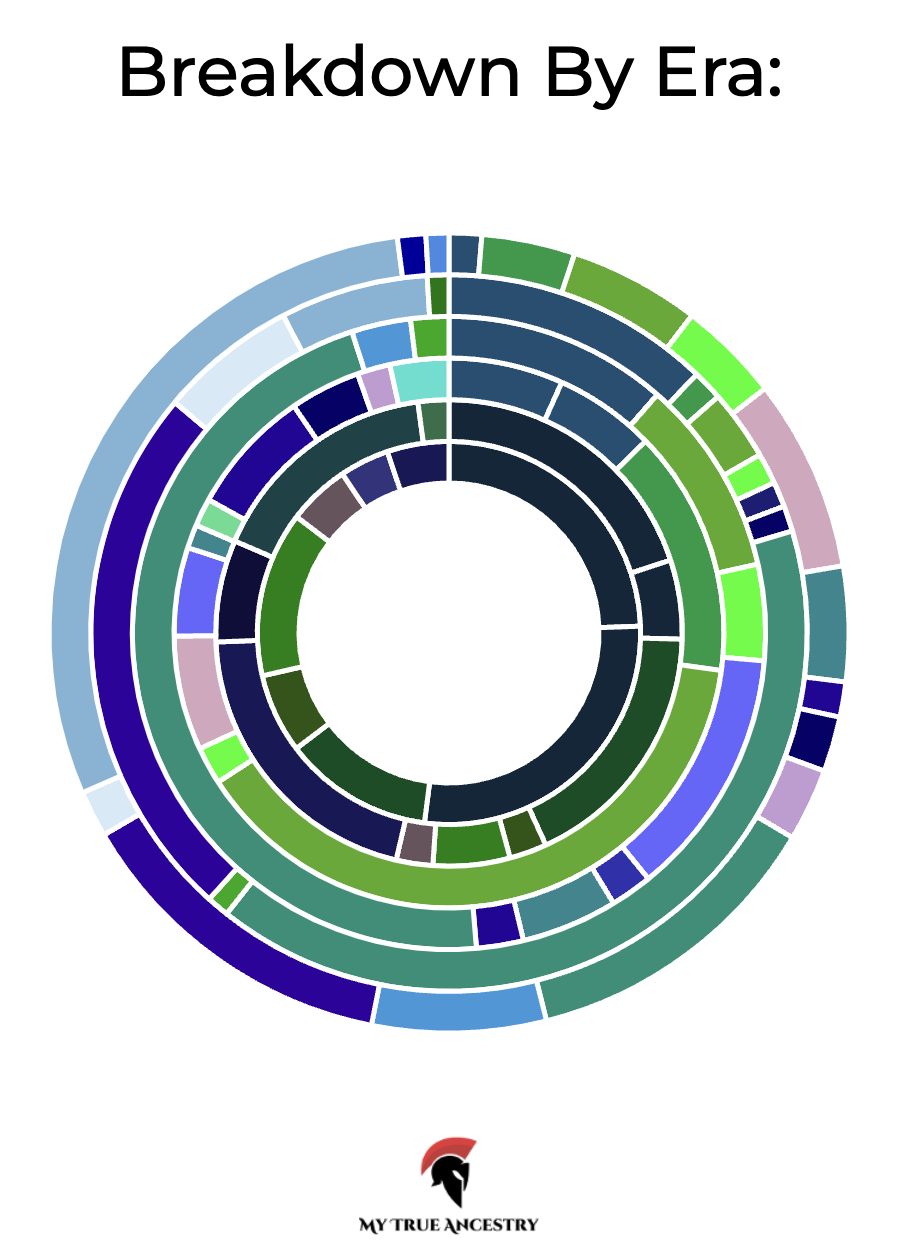
Neolithic:
- Proto-Ostrogoth 27.6%
- Proto-Visigoth 24.4%
- Proto-Gael 12.6%
- Proto-Celtic Dobunni 6.7%
- Proto Celt 14%
- Proto-Western Scythian 5.2%
- Proto-Cherusci 4.2%
- Proto-Longobard 5.2%
Early Bronze Age:
- Proto-Visigoth 19.9%
- Proto-Ostrogoth 5.5%
- Proto-Gael 17.8%
- Proto-Celtic Dobunni 2.6%
- Proto Celt 5.3%
- Proto-Western Scythian 2.5%
- Proto-Longobard 20.7%
- Proto-Unetice 7.1%
- Proto-Goth 16.4%
- Proto-Celtic Cantiaci 2.1%
Iron Age:
- Visigoth 6.7%
- Ostrogoth 6%
- Gael 14.5%
- Celtic Dobunni 38.7%
- Celt 2.2%
- Western Scythian 6.7%
- Cherusci 5.2%
- Goth 1.4%
- Celtic Cantiaci 1.6%
- Vandal 7.4%
- Gepid 4.1%
- Scythian 1.9%
- Osi 3.5%
Roman Age:
- Ostrogoth 11.4%
- Celtic Dobunni 10.1%
- Celt 4.9%
- Cherusci 12.7%
- Longobard 2.1%
- Goth 4.9%
- Vandal 2.4%
- Frank 46.4%
- Swedish Viking 3%
- Gaul 1.9%
Dark Ages (Saxon Times?)
- Visigoth 12.2%
- Gael 1.4%
- Celtic Dobunni 3.2%
- Celt 1.4%
- Unetice 1.1%
- Gepid 1.2%
- Frank 40.3%
- Gaul 1%
- Belgae 1%
- Anglo Saxon 24.5%
- Norwegian Viking 6.2%
- Danish Viking 6.7%
Medieval Age:
- Visigoth 1.3%
- Gael 3.8%
- Celtic Dobunni 5.3%
- Celt 4.1%
- Western Scythian 7.8%
- Goth 4.6%
- Vandal 1.4%
- Gepid 2.2%
- Scythian 2.9%
- Frank 12.5%
- Swedish Viking 7%
- Norwegian Viking 1.9%
- Danish Viking 29.5%
- Anglo Saxon 13.5%
- Saxon 1.1%
- Svear 0.9%
 Leaves on the Tree