The Trouble with Nathan (Part 2) – Who were Nathan’s parents?

In my first post about the old codger Nathan (a nice gentleman, I’m sure) I discussed the frustrating lack of information regarding his birth, death, or indeed much of his life.  Speculations as to why the bugger seemed to drop off the face of the Earth were also included.

When tracing a family line backwards through time, one is always searching for the next link: an individual’s parents.  I know that Nathan lived and had a wife and a family – and that might be all we will ever know of him.  So my next task must be to find the next link: Nathan’s parents.  The problem here is that it is typically through records of a child’s birth that we find information about his or her parents.  And since Nathan was not kind enough to leave any evidence that he was ever born, his parents also remain a mystery.

So, who were Nathan’s parents?  Below are some possibilities that I have researched.  Two have become dead-ends, whereas the third remains an open possibility.

Theory #1: Nathan’s parents may have been Quaker immigrants to Philadelphia
Likelihood: Not very likely

For many years, my grandfather, Russell Thomas, sold books.  Many of them were antiques or generally valuable.  As a result, we have ended up with a few.  One is a thick volume entitled “The Merion Tract,” which details the migrations of Quakers to Pennsylvania.  Since many Quakers came from the British Isles, and the Thomas’s supposedly came from Wales, and I had this book in my possession, I carefully went through its pages.  Several times.  Any of the very few Thomas’s mentioned either had no children or only had daughters – so the surname of Thomas would not have continued.  And, none of them were named Nathan.

Theory #2: Nathan’s parents may have been British Royalists living in PA during Colonial times
Likelihood: Possible, but difficult to prove

I learned of this British Thomas family from chapter 19 of the book “History of Bucks County” (available via Google Books).  Page 592 of this book briefly discusses Lewis and Evan Thomas who owned large portions of land “in the northwestern part of the township near Rieff’s corner, and eastward from the village of Telford.”  These men, perhaps brothers, were “wealthy and aristocratic” and owned slaves prior to the Revolutionary War.  Though a family cemetery is located “on the Bethlehem turnpike a half-mile above its divergence from the county line,” in which many slaves were also said to be buried, any evidence of the existence of a grave site has been destroyed.  The book goes on to say that one Richard Thomas was the head of the family before the war, and that his sons William and Evan were in the British army.  I have researched all of these names within the time frame of the Revolutionary War, but have not found any sons of the aforementioned men that might have led to a Nathan Thomas.  Regardless, the desecration of their cemetery is appalling, and for simply posterity’s sake and out of respect for the deceased I would like to locate the approximate location of their family cemetery some day.

Theory #3: Nathan’s parents were Welsh immigrants who founded a Baptist Church
Likelihood: Possible, probable, and plausible, but difficult to prove.

Ancestry.com has a neat feature in which you can link individuals in your own tree to identical individuals in another researcher’s tree (we’re all related somehow, I’m starting to think!).  In doing so, you can gather information from the other researcher’s tree that perhaps you did not know.  This is how I came across the possibility that Nathan may be descended from Welsh immigrants.  I have Nathan plugged into my ancestry.com tree.  A little over a year ago, the website alerted me that another researcher potentially had the same Nathan on their tree as well.  I took a look to see if these two Nathan’s shared any similar information.  Indeed, the other researcher’s Nathan had all the same information that my Nathan has… and ALSO listed a father.

At first I jumped for joy and all but poured myself a celebratory glass of bubbly.  A few more clicks of the mouse pad and I learned that the Josiah Thomas (1784-1856) that was listed as Nathan’s (possible) father was the great-grandson of one William Thomas, who immigrated from Monmouthshire, Wales.  A bit more digging on the internet is how I found the book “History of Bucks County” in the first place, and it gave me much more information on the man who could be our link back to the “old country.”  Pages 590 and 591 of the book (linked below) detail his family’s initial misfortune when immigrating to Pennsylvania from Wales, their eventual prosperity in the new world, and William’s founding of the Hilltown Baptist Church.

As fantastic as it would be to finally call the mystery of Nathan solved and closed with the discovery of this Welsh family with possible connection to our Thomas line, there is not yet enough evidence to know for sure whether Josiah was Nathan’s father.  I’ll write more on the evidence I have, and the evidence I still need to find, in another post.  This one is getting long enough.
The Trouble with Nathan (Part 1) – Why did he disappear?

The earliest Thomas ancestor in America whose connection can be confirmed by public records is one Nathan Thomas. 
Unfortunately, little information is available regarding Nathan.  Here is what is known:
  • No record of his birth, death, or burial has been found to date. 
  • Record of his marriage to Hannah Renner on June 28, 1829 at Tohickon Union Church exists in the records of this church. 
  • His name appears in the 1850 Census but in no census thereafter. 
  • According to this census, Nathan was 42 years old in 1850, making his estimated year of birth 1808. 
  • He is also listed as residing in the Milford Township of Bucks County along with his wife and three children: Hannah, Lucinda, and Nathan.  Little is known about these three children. 
  • Nathan’s eldest known child, Jeremiah, from whom we are also directly descended, was born in 1831 and, at the age of 19, was likely already living and/or working outside of his parents’ home – hence is absence from the 1850 census.
More information exists regarding Hannah, who was born to Adam (1780-1823) and Elizabeth (1775-1819) Renner and was one of at least ten children.  Though she is listed along with her husband in the 1850 census, the 1860 census lists her living with her brother, John, and in 1870 living with her son, Jeremiah.  Church records indicate that she is buried at St. John’s Lutheran Church in Ridge Valley with many of her children and grandchildren, though her tombstone has not been found.
 
So why is information about Nathan’s existence so elusive?  Here are some speculations:
  • Nathan may have been born out of wedlock.  The couple who I have found to possibly be Nathan’s parents were married after Nathan’s estimated birthdate.  Depending on the stringency of the church at the time, a person born prior to his parents’ marriage may not have been permitted to be baptized and thus may not have been permitted to have a proper funeral or be interred in holy ground.  Or, if a “secret” baptism or funeral did take place, it may have gone unrecorded.  I have asked some Lutheran pastors about the possibility of this.  Though they were not sure and said that it would have been awfully strict of a church to deny a child baptism and, later on, burial rights, they did indicate that it could be possible.
  • There is a legend of an escaped prisoner in the family.  It is unclear if this gentleman was a prisoner of war or jailed for some other reason.  The story goes that the convicted Thomas gentleman would, each day, challenge a prison guard to a race around a distance tree and back.  Thinking this a harmless activity, the guard obliged.  Harmless and innocent the pastime remained until Mr. Thomas pulled the wool over his guard’s eyes; after weeks of building up his strength and stamina with simple races around a tree, one day Thomas kept on running and was never caught.  The legend continues that his family hid the convict in “Thomas Woods.”  Could “Thomas Woods” be in Tylersport, where Nathan’s sons and grandsons lived and ran an inn?  If Nathan were the escaped convict, it would explain his sudden disappearance from his family unit and the lack of record of his death or burial.  Furthermore, it is unlikely that Nathan would have been a prisoner of war, as his disappearance prior to the 1860 census puts him off the map years before the Civil War.
 

Thomas – Welsh Connection

I first began genealogical research after hearing the claim that the last Welsh prince of Wales (before Britain took over) was a Thomas.  Welsh history is complex, with Welsh names and the ancient ways of clans & chieftains not making things any easier to understand.  For a while, I thought that the last Welsh prince of Wales was Llewellyn ap Gruffydd, who put up a massive fight against the British.  Clearly, however, Llewellyn was not a Thomas.

Recently I read yet another claim connecting the Thomas line to Welsh royalty, but this time more specifically.  Though “House of Names” is certainly not the most reputable historical source, it’s claim that the name Thomas was “first found in Breconshire, where the family claims descendance from Owen Glendower, Lord of Glyndwyrdwy, Prince of South Wales” gave me more to go on.

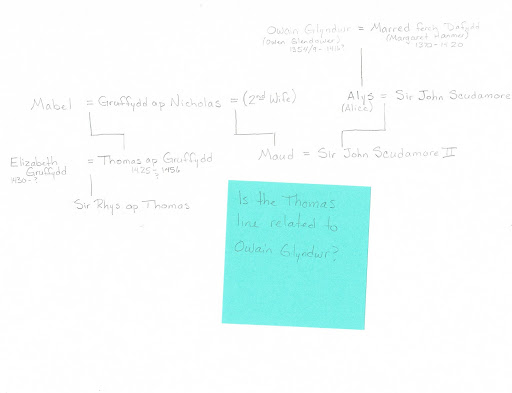
Owen Glendower, known to the Welsh as Owain Glyndwr, had his name anglicized by Shakespeare when he appeared as a character in Henry  IV.  He was the last native Welshman to hold the title “Prince of Wales,” and was also a descendant of the previously mentioned Llewellyn ap Gruffydd!  A little more digging resulted in this page, which shows a connection between Owain and a Sir Rhys ap Thomas (yet another prominent figure!)

Perhaps it is through this Sir Rhys ap Thomas that the Thomases in Breconshire claim to be descended from Owain Glyndwr.  I set upon connecting Owain’s and Sir Rhys’s family trees with success.  However, their connection is only through marriage; there is no blood relation.

Another problem with this theory is that, although it appears that Sir Rhys has the surname “Thomas,” Welsh names do not function like ours do, and Sir Rhys’s son’s name was Sir Griffith ap Rhys.  So, the Thomas link ends there.

In desperation I wrote to the president of the Owain Glyndwr Society in Wales, asking if he was aware of any connection between Glyndwr and the Thomas line.  About two weeks later (mid-July), I received a snail-mail reply from Mr. Adrien Jones, who was unable to directly answer my question, but gave names and addresses of two Society members who are descended from Glyndwr who may be of greater assistance.

Today I received another note from Mr. Jones with two additional contacts, one of whose address is in the House of Commons, Westminster, London.  He also indicated that he has sent letters to two newspapers.  As far as I understand, posting letters to newspapers in that area of the globe is a way of publicly announcing that you are in search of something or information.  Hopefully he will receive some replies!