Died: November 29, 1941 (Buried at St. Mark’s Lutheran Church, Pennsburg)
Spouse: Alice H Fox
Born: October 1, 1884
Died: June 12, 1948 (Buried at St. Mark’s Lutheran Church, Pennsburg)
Married: Date unknown
Occupation: Cigar maker, silk mill weaver, worker in a trunk factory
Children: William, Margaret, Russell
The oldest child of William and Mary Thomas, Philip was born on August 4, 1888 in Bronx, NY. He most likely attended school and may have worked in a cigar factory alongside his father.
In his late teens, Philip moved back to Pennsylvania with his parents and younger siblings. He returned to work in factories but did not continue school past his second year in high school. The 1910 census lists Philip as a boarder in another family’s home (the surname is unfortunately illegible) on Main Street in Red Hill. At the time, he was 22 years of age and worked as a cigar packer in a cigar factory.
Philip married Alice Fox, who was born on October 1, 1884, and whose life and lineage is detailed in the FOX portion of this site.
Considering how recently Philip Thomas lived there is a surprising lack of information about him as a person. His youngest son, Russell Thomas, does not have very much to say about his father’s life when asked:
“What I know mostly about my father was that he was from Tylersport… He was just a factory worker. He worked in the trunk factory in Pennsburg. That’s burned down. Then he was in textiles. You know, they had those silk mills around here. A lot of time he was unemployed… during the depression.”
Russell also recalls that they moved around a lot when he was young. Census records also reflect the family’s financial difficulties and Philip’s unsteady employment during the Great Depression.
In 1920 the family lived at 149 Main Street in Pennsburg. Philip was a cigar packer in a cigar factory. Although addresses may have changed since that time, modern maps show 149 Main Street as not too far from the house where Alice Fox, Philip’s wife, grew up: 70 Main Street, just across from St. Mark’s Lutheran Church.
Philip Thomas’s 1920 residence at 149 Main Street
By 1930, the family lived at 584 Main Street in Pennsburg. At this time, Philip was a weaver in a silk mill, and his daughter, Margaret, was a cutter in a knitting mill. According to the census, the family’s monthly rent was $18. Sometime before 1935 the family also lived on Seminary Street, as Russell recalls walking with his mother from his home on Seminary to visit his maternal grandmother, Rebecca Hess, at her home at 70 Main Street. His mother also worked at a cigar factory across from the railroad station on Seminary Street. Their stay there must have been short lived, however, since this address does not appear on any census records.
This home may be the Thomas’s residence at 584 Main Street in 1930
By 1940, the family lived at 434 Main Street in East Greenville and Philip continued to work in a silk mill. Alan Thomas, grandson of Philip Thomas, recalls that the house was half of a twin and had only coal stoves in rooms rather than central heating. Interestingly, this house is only a handful of doors down from the Heimbach residence, where Russell’s wife, Pearl, grew up.
The home on the left is 434 Main Street, the Thomas’s 1940 residence. The far right side of the row home to the right was the Heimbach household.
Philip died on November 29, 1941 of a heart attack, as did his father and grandfather. There is some speculation within the family that the economic hard times and his periods of unemployment led Philip into a habit of drinking.
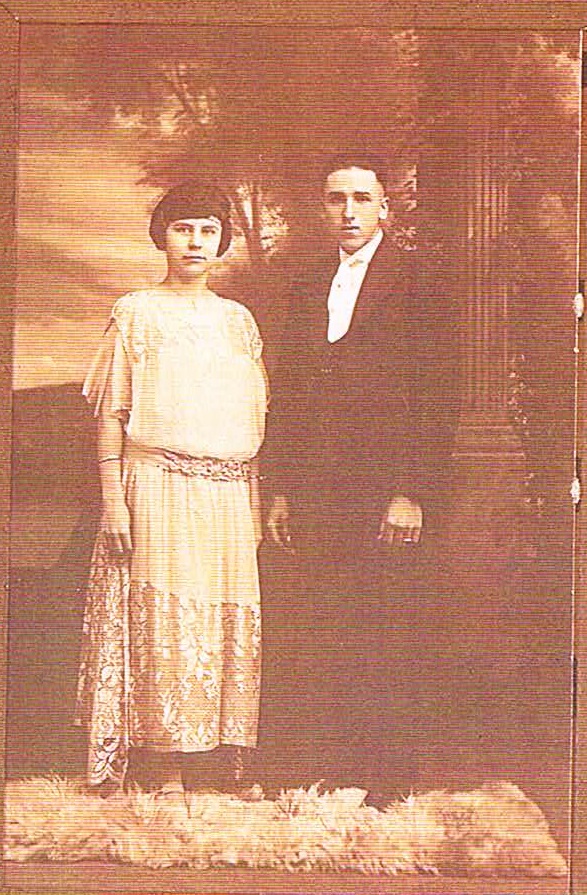
One could say that factory work was a way of life for the extended Thomas-Fox family. The undated photo below is the only photo anyone has of Philip Thomas. Also pictured is his cousin, Charles. Philip and Charles were married to sisters Alice and Andora Fox. All worked together at what is believed to be a factory on 4th Street in Pennsburg.
Possibly the 4th Street Cigar Factory
Philip Thomas’s Draft Card from World War I (Philip was never drafted to serve in the war)
After his death, Philip’s wife, Alice, became diabetic and remained at home. She was taken care of by her daughter, Margaret, until Alice’s death on June 12, 1948. Both Philip and Alice are buried at St. Mark’s Lutheran Church Cemetery in Pennsburg.
Died: 1918 (Buried at St. John’s Lutheran Church Ridge Valley, old cemetery)
Spouse: Mary Veth
Born: 1867 in New York City (Buried at St. John’s Lutheran Church Ridge Valley
Died: 1848
Married: 1887
Occupation: Cigar maker in the Bronx, NY; Cigar maker at Allen Cressman’s Sons Cigar Factory, Tylersport, PA; Night watchman at the tower of the Philadelphia and Reading Railway Company, Sellersville, PA.
Children: Philip, Anna, Ellen, William, Milton, Jeremiah, Harvey, Jacob, Charles
William Thomas was born in October 1861, most likely in or near Tylersport. As a young man he moved to the Bronx, NY, where he worked in a cigar factory. It is possible that both he and his younger sister, Hannah, traveled to New York together in search of work as industry began to boom after the close of the Civil War. However, although Hannah lived in the city at the same time, also married in New York, and returned to Pennsylvania sometime before 1920, she has not been found in any New York census records between 1880 and 1910.
In 1887 William married Mary Veth, who was born in New York and was the daughter of German immigrants John (b. 1827) and Rosanna (b. 1831) Veth. According to the 1900 census, the couple and their first five children lived at 629 East 153rd Street. Google images of this address now show empty lots where houses once stood, and the neighboring streets are full of buildings, now either vacant or occupied by stores and apartments, that were likely factories around the turn of the twentieth century. Which one was the workplace of William can only be speculated. On a neighboring street is the old South Bronx High School building, now the Mott Haven Village Preparatory High School, which their older children may have attended. This neighborhood is near the modern Yankee Baseball Stadium.
By the 1910 census, William and Mary had returned to Salford Township, Pennsylvania, and lived on Allentown Road (near or in Telford and near the Ridge Valley church) along with their first five children and Mary’s mother, Rosanna. Back in Pennsylvania, the couple had four more children. William returned to work at Allen Cressman’s Sons Cigar Factory. His oldest daughter, Anna, also worked in a cigar factory at this time.
The Family’s Home
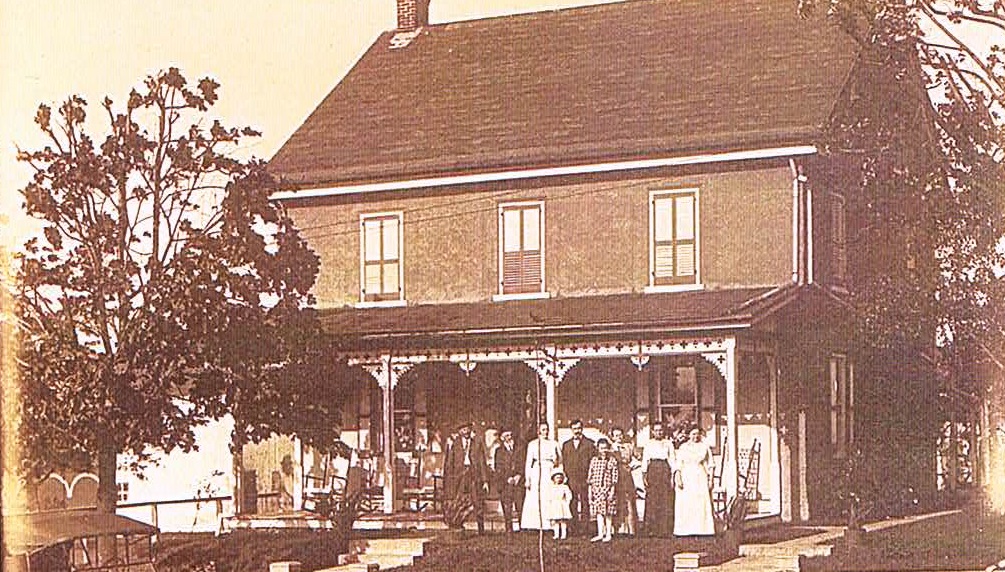
Years ago, William & Mary’s grandson (Henry, son of Jacob) gave me a copy of a photo of what was referred to as the Thomas’s inn or hotel. Henry and my grandfather both said that Jacob owned and lived at a hotel or inn in Tylersport:
Obviously, the hunt for this home began. But it also quickly ended, because with nothing other than the town of Tylersport to go on (and living in another state, myself), it was a 100-year-old needle in a haystack.
Earlier this year (2022), with vague recollections of something about this home being at the top of a hill, and something about the roads Ridge Road and County Line, I literally scrolled around on Google Maps. While there is a crossroads of Ridge Road and County Line Road in Tylersport – with a sizable old tavern still existing on one corner, two old homes on others, and one empty lot – the buildings there were no match.
Then it dawned on me that census records in the 1900s began including addresses.
In 1910, William & Mary and their 9 children (and, presumably, their daughter Ellen’s husband) lived on Allentown Road in the township of Salford, having moved back to Pennsylvania from the Bronx in the last decade. In 1920, William was deceased, but Mary continued to live on Allentown Road with several of her children (including Anna’s husband and son).
By 1930, censuses added house numbers, and the family is listed at 51 Allentown Road in Telford. The head of household was now 28-year-old Jacob, son of William and Mary, along with his wife Miriam and their first two children, Pauline and Ruth. By 1930, Mary was living elsewhere with her daughter Anna and son-in-law Henry Fitzgerald. According to Thomas Chappell, one of their great-grandsons, Mary had a stroke “shortly before 1940” which left her an invalid and unable to speak. Anna and Henry took care of her 6 days a week. Mary’s other daughter, Ellen, and son-in-law Norman lived at the adjacent address and took care of her on Saturdays.
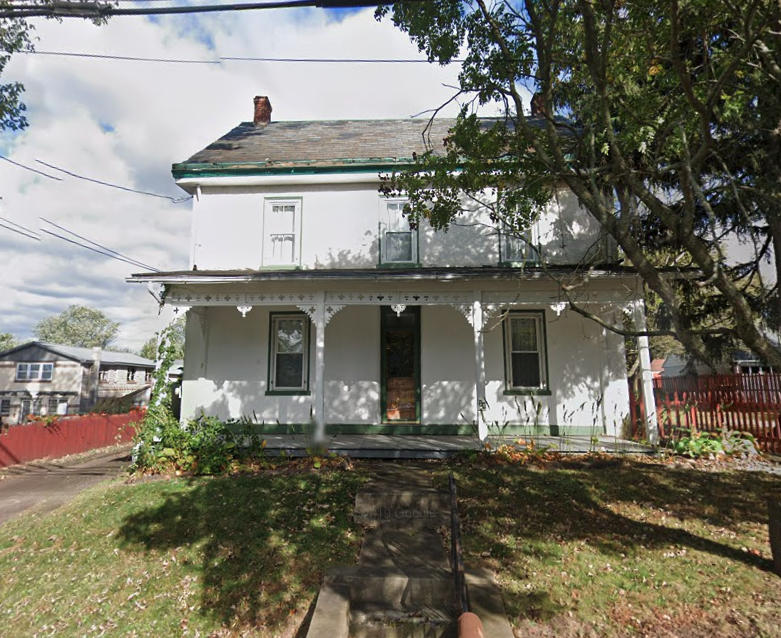
Google Maps has become a great tool for locating old family residences. Allentown Road has since been split into a “north” and “south.” Only North has a 51, and the dwelling certainly did not resemble the photo above. However, one just a few doors down did:
And there she is. The bricks have been whitewashed, the trees have grown, but the lovely trim and path and even diagonal gutter on the side of what is now 39 N Allentown Road are exact. It is maybe 2000ft from that intersection of Ridge and County Line Roads, and very near the church that William, Mary, and many more generations attended and are buried at. According to Zillow, the home was built in 1900 and now has 4 bedrooms. For a family at the turn of the 20th century, it seems a large home. But, William and Mary did have nine children who lived here.
But was it an inn? I’m not convinced, even though the tale of the inn comes directly from Jacob’s son. Census records and his obituary list Jake as a butcher or factory worker. No mention of an innkeeper, and I doubt he would have had time to run an inn with a factory job and, as was typical for the time, food to grow and livestock to tend. That said, censuses make it sound as though Jacob was an independent butcher; perhaps he worked from home and could have overseen boarders. The home certainly could have had room to spare for a traveler or two.
At the intersection of Ridge and County Line there is an old tavern, which was almost certainly an inn at the time. Perhaps someone in the family worked there, or perhaps its proximity just led to a story not exactly rooted in fact. Since Jacob died in 1993, we probably won’t ever know.
William lived to be 57 years old. Late in life he took a new job as a night watchman in the tower of the Philadelphia and Reading Railway Company at Sellersville. This job was not a long-lasting one, however; according to his obituary, William suffered a heart attack his second night on the job, and his body was found in the watchtower by the day watchman upon arriving to work. This was in the year 1918, though the exact date of William’s death is unknown. William was also a member of the Tylersport chapter of the Patriotic Order of the Sons of America, which published an additional obituary.
Obituary of William Thomas
Following William’s death, Mary continued to reside on Allentown Road with her children. Mary died in 1948 at the age of 81. She and William are buried at St. John’s Lutheran Church in Ridge Valley, near William’s parents.
Anna O., the couple’s oldest daughter, was born in October 1891 in the Bronx. After returning to Pennsylvania she worked in a cigar factory. She married Henry H. Fitzgerald at St. John’s Lutheran Church in Ridge Valley on February 22, 1912. They had two children, named Henry and Charles. Anna died in 1978 and is buried with her husband at St. John’s.
Ellen F. was born on January 14, 1893 in the Bronx. She married Norman Royer in 1910, after returning to Pennsylvania. They had three children named Norman L., Russell S., and Mary. She died on July 14, 1962, and is buried with her husband at St. John’s.
William J. was born in August 1895 in the Bronx. Like his father, he was a member of the Patriotic Order of the Sons of America. He died at the age of 22 of pneumonia and is buried alongside his parents at St. John’s.
William J’s Obituary
Milton J., often called “Mook” by his family, was born in March 1897 in the Bronx. He married Elsie Klein on August 1, 1929 and had two daughters named Esther and Mary. He died on August 5, 1970 and is buried in Christ Union Cemetery in Trumbauersville.
Jacob, also known as Jake, was born on February 5, 1902. He married Miriam Nase (born Dec. 5, 1903; died June 11, 1997; daughter of Charles & Carrie Nase) and had seven children: Pauline, Ruth, Mary, Jacob, Janet, Henry, and Carl. According to his son, Henry, Jacob owned and lived in a hotel in Tylersport (see the above story and photo of the purported hotel/inn). Jacob died on March 30. 1993 and is buried with his wife at St. John’s.
Jeremiah, also known as Jerry, was born on November 27, 1903 and baptized at St. John’s on March 20, 1904. He married Mabel Breisch (born Sept. 17, 1906; died Feb. 25, 2008, at the age of 101) and had three children named Nancy, Paul, and Barry. Jeremiah died September 8, 1997 and is buried in the Sellersville Cemetery. Russell Thomas once mentioned that Jeremiah had a barber’s shop in his brother, Jacob’s inn. Russell also recalls some details about the lives of Jeremiah’s three children: Paul, who lived from August 24, 1928 to August 31, 2011, played for the Orioles baseball team when it was a farm team for the NY Yankees. He died in South Carolina. Barry was a highly acclaimed football player who played for the Citadel. According to Russell, who recalls watching one of his games on New Year’s Day, the “papers were full of him,” and he “could have gone pro but his mom didn’t want him to.” Nancy left Pennsylvania and moved west.
Harvey was born on September 3, 1905 and baptized at St. John’s on May 27, 1906. According to Russell Thomas, his nephew, Harvey was a racketeer. He owned a gas station and sold tires on the black-market during WWII, when many such materials were strictly rationed for the war effort. Russell says that he “played horses” at racetracks and “always had a pocket full of money.” Harvey did marry, though her name has not been remembered by anyone in the family or found in any of my research. According to Russell she worked in the top offices of Sears and didn’t associate with the Thomas’s very much: “not that she was nasty, she just went her own way… Why she married [Harvey] I’ll never know!” Harvey died on August 9, 1985 and is buried in the Fairview Cemetery in Boyertown.
Charles O was born in 1910 and died in 1944. He is buried in the St. Philip Neri Catholic Church cemetery in Pennsburg. All other information here about him comes from the personal knowledge of his nephew, Russell Thomas, and his grandson, Scott Thomas:
Charles O was a great baseball pitcher for the Perkiomen township team, part of what was known as the “Twilight League.” Russell recalls watching him strike out 17 of 21 batters: “I knew who he was, and I watched him pitch ball when I was around 12 or 14 years old.”
According to Scott, Charles O met Catherine Klein through her brother, William Klein, who also played baseball. According to Russell, Catherine lived on Main Street in Pennsburg. He says that she “was on the wild side,” and would often “hang out with a bunch of boys.” Scott recalls that she was also into bowling.
In 1933, Catherine had a child, whom she named Charles F Thomas, and claimed that Charles O. was the father. At the time, Catherine was 17 years old and Charles O was 23. Charles O and the rest of the Thomas family denied that the baby was his son. He spent a few days in jail for denying the child was his and for refusing to marry Catherine. According to Russell, the incident was “a sore subject in the Thomas family,” who never accepted the possibility that the baby could be a Thomas. Young Charles F, however, was determined that he was a Thomas.
According to Scott, Charles F was mostly raised by his grandmother, Amanda Klein (Catherine’s mother). The younger Charles only saw his father twice: once when he was injured as a child and in the hospital, and at his father’s funeral.
Charles O later married Anna Welck in 1939 and lived with her, his mother-in-law, and step children on Ridge Valley Road in Salford until his death. He died in 1944 at the age of 34, some say as a result of alcoholism.
Like his father, Charles F was also a baseball player, and as a bat boy he met his cousin, Paul (Jeremiah’s son), who later played for the Orioles. Charles continued to play baseball into his 40’s. He graduated high school in 1952 and joined the army, just barely missing going to Korea. He married Elizabeth Stoudt (b. 1933) and had three children: Sharon, born in 1957; Charles F, born in 1960; and Scott, born in 1963.
Catherine Klein later married Roland Heffentrager and lived on 3rd street in Red Hill for many years. She died in 1992, and she is buried at St. Paul’s Lutheran Church in Red Hill. Scott Thomas, her grandson, had the opportunity to get to know her and says that she was a very sweet lady.
Photos
Jacob Thomas’s Inn in Tylersport. Though many Thomases are photographed here, their names are unknown
Anna (Thomas) & Henry Fitzgerald
Miriam (Nace) & Jacob Thomas
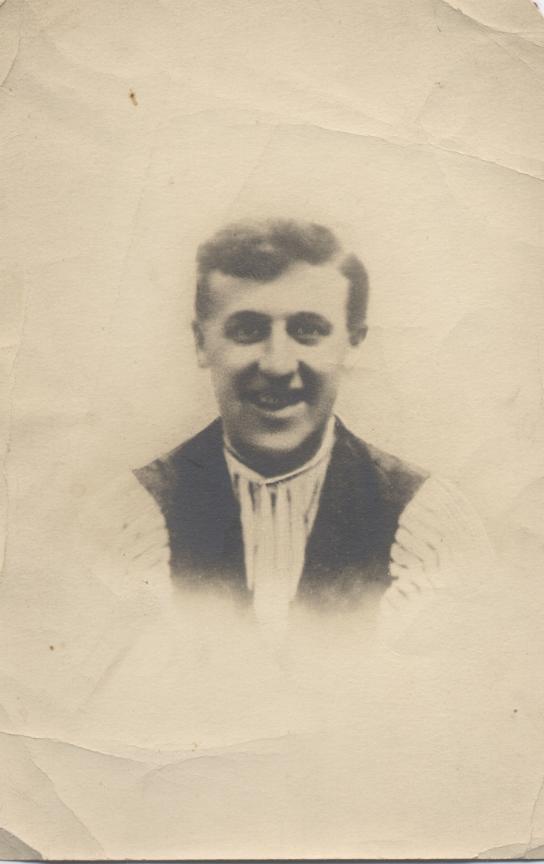
William J Thomas
Gravestone Photos
Gravestone of Charles O Thomas
Gravestone of Catherine (Klein) Heffentrager
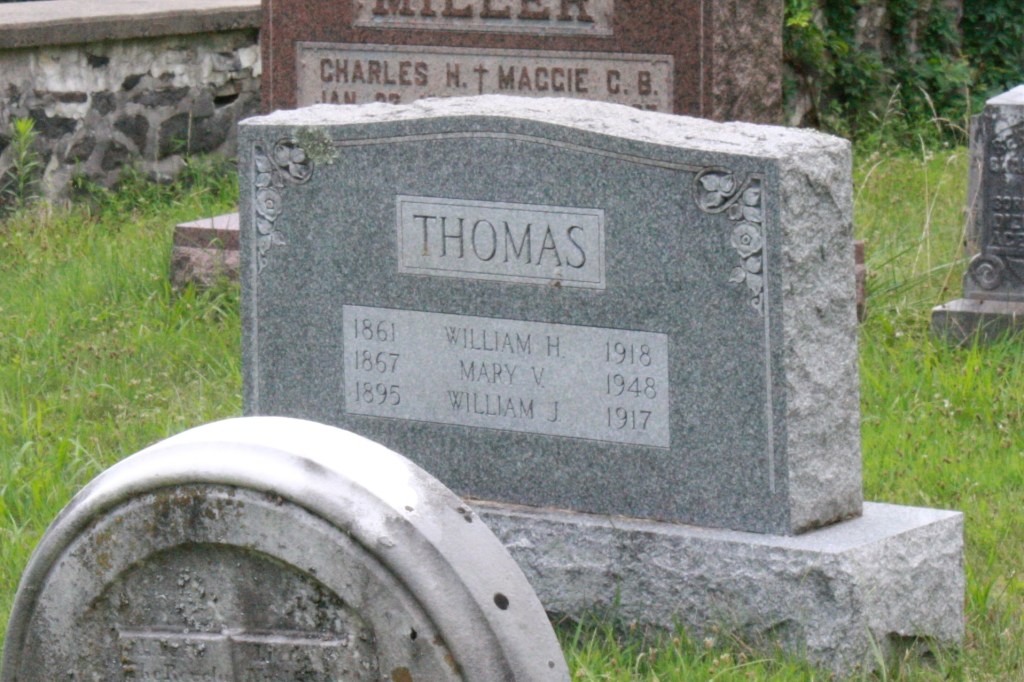
Gravestone of William, Mary, and their son William J
For generations, family legends told of a young Thomas who went westward to seek his fortune, but instead met an untimely and tragic demise. Though many separate tales of “lost Dutchman miners” exist across the western states, one such miner was Henry Thomas, son of Jeremiah and Sarah Ann. A Dutchman he was not, but rather a man from Pennsylvania, where the German-American dialect known as “Pennsylvania Deutsch” was spoken. Though “Deutsch” is literally the German for “German,” this dialect, and those who spoke it, were and still are often referred to as “Pennsylvania Dutch.”
The Legend
Though the newspaper articles provided here detail the accident in which he died, stories passed through the family instead held a greedy partner accountable for Henry’s death. The legend as I heard it was passed to my mother, Martha Thomas-Beard by her aunt, Margaret (Thomas) Weisel. Margaret told of a Thomas ancestor who went west to Colorado (whether or not he was the same individual who purportedly escaped west after fleeing prison was unknown but speculated). Margaret was unsure of what the man’s name was, only that he was a Thomas. She told that Mr. Thomas and his partner discovered a very well loaded silver mine, one that only they knew the location of. While on the way into town to register the mine, thus giving themselves legal rights to it, one partner shot the other, hid the body, and registered the mine in his name alone. However, on the way back to the mine the partner was struck and killed by an avalanche. It was said that neither his body nor the precious silver mine were ever found. Whether or not this is how the incident truly happened, we will never know.
The Official Story
Newspaper articles detailing the incident tell a different tale, instead recounting a snow slide which demolished Henry and his colleague Sutton’s cabin, burying him under the snow. The following articles detail the tragic event, as well as the “largely attended” funeral, complete with brass band.
Four of these articles are from the Durango, Colorado newspaper “The Idea.” These articles were graciously researched and provided by Ms. Julie Pickett of Durango, Colorado.
The following articles about Henry Thomas’s death from an unknown Pennsylvania newspaper, as well as translations of the articles into English, were provided by his great-nephew Henry Thomas of Pennsburg (grandson of William H. Thomas and son of Jacob).
Article translations:
Article 1
A tragic incident. The frozen Mr. Henry H. Thomas buried.
We reported a few weeks ago that a snow avalanche smashed the hut of two gold miners in Colorado; that one by the name of Sutton was able to save himself, while the other Henry H. Thomas, son of the Constable Thomas in Tylersport, was unable to get away and had to be left behind by his companion. When Sutton brought the news to the next settlement of Durango, it caused a great stir, because the people believed that they were perhaps still able to rescue him; and James Bradley, a former companion of Thomas undertook to look for the victim of the accident. He left Durango about 4:00 o’clock on Saturday afternoon on horse and rode to Fort Lewis. There he took snowshoes and went to Parrott that night. From there William Vailes accompanied him and both of them went early in the morning and climbed up the La Plata Gulch and reach the place of the accident Monday morning at 3:00 o’clock. They found the hut destroyed by the avalanche the way Sutton had described it. The end of the gable stuck out of the snow about 30 feet below the spot where the hut originally had been, and a quantity of dried fruit, sacks for ore, ropes, a wheelbarrow, and other articles were scattered further down the mountain. By means of a pole they were able to find the body. It lay by the hut under about 10 feet of snow. It lay on its back, stretched out with hands crossed over his chest. He was just wearing a shirt, a pair of pants, and thin socks. His face looked natural.
Thereupon the men made a sled from the snowshoes, wrapped the body in canvas and started on their way home. The snow was about 13 feet deep on the even stretches of the way, and about 18 inches of fresh snow fell on Monday. It was storming terribly all day long. After they had gone 2 (7?) miles, they became tired and exhausted from the storm. They decided to go to the Monitor Mines about 3 miles up the mountain to get help. In the Monitor Hut they stayed until Tuesday morning, where they were accompanied by the men Righter and Scott in order to return to the place where they left the body. The four men brought the body at 11:00 o’clock at night to La Plata. Here Hampton and his son joined them and together they all arrived at Parrott and from there the next morning they reached Fort Lewis. From there the military authorities took care of transporting the body to Durango to the morgue. The body thawed out during the night, and the next morning the doctors were able to examine it. His right ankle was broken and his right arm injured, and the head and other parts of the body were badly scratched and bloody. All the signs showed that Thomas died from his injuries and from freezing. It was the opinions of the doctors that he lived for several hours after Sutton had left him, and if Thomas had been able to wait until the rescue, he would have been able to recover from the injuries.
The accident victim was the son of Jeremiah Thomas from Upper Salford Township and was about 30 years of age. He was an industrious man, a good miner, one of the best in San Juan. He had some valuable possessions in that area which his sister in New York will inherit.
Article 2:
Durango, Colorado, January 28th
From the extreme southwest part of the state another snow avalanche was reported. Leonard Sutton who worked in the Silver Lake Basin was in the La Plata Mountains, arrived at Durango last night and reported that last Tuesday an avalanche demolished the hut by Daylight Mine and buried it. Sutton, who sat with Henry Thomas in the hut, succeeded to dig himself out of the snow. He also found his partner 10 feet under the deep snow, but had to leave him behind due to his broken leg and internal injuries. Thomas begged Sutton to kill him in order to put an end to his misery. Sutton hesitated to do that. Thomas then asked Sutton to leave him immediately and save himself; in the spring he could return to get the body, and to send his money and possessions to his sister in New York. Since Sutton believed that Thomas could only live a few more minutes, he gave in to his companion’s wishes and left his partner to his fate.
This article appeared in the New York Herald on January 27, 1886:
Lost & Found
At the time of our communication, Ms. Pickett was researching the names of those interred in the Animas Cemetery whose gravestones have been lost or destroyed by vandalism. Henry Thomas was one such individual. His name has since been added to the Animas Cemetery website, which lists all those individuals laid to rest there:
Henry H. Thomas
Born: About 1855 in USA
Died: 19 Jan 1886 in Silver Lake Basin in the La Plata Mountains, CO, USA
Henry was killed by an afternoon snowslide that slammed against the cabin in which he waiting for a snow storm to abate. He was buried under 15 feet of snow, but was dug out by his mining partner who then left him behind at Henry’s request. A short time later he succumbed to the freezing temperatures. Before his partner left him, Henry wrote a letter to his sister Hannah Thomas of New York City. His obituary stated that he was buried in the Animas City Cemetery, but there is no engraved headstone marking his grave.
Died: July 23, 1903 (Buried at St. John’s Lutheran Church Ridge Valley, old cemetery)
Spouse: Sarah Ann Hetrich (aka Hotrich or Hetrick)
Born: June 19, 1830
Died: Feb. 27, 1907 (Buried at St. John’s Lutheran Church Ridge Valley, old cemetery)
Daughter of Joseph Hetrick (1803-1894) and Sarah Ann Erney (1801-1885), also buried at Ridge Valley
Married: January 15, 1853 at the Tohickon Reformed Church
Occupation: Constable of Tylersport, according to family legend
Children: Milton,William H, Henry H, Hannah E, Anna Catharina, Maria Jane, Sarah Alice
Sadly, little is known about the life of Jeremiah Thomas except the facts surrounding his family. He was born May 2, 1831 and died July 23, 1903 at the age of 72.
Legend tells us that he was the constable of his hometown of Tylersport. He married Sarah Ann Hetrich / Hotrich on January 15, 1853 at Tohickon Reformed Church (now St. Peter’s UCC in Perkasie), the same church at which his father, Nathan, and presumed grandfather, Josiah, were also married.
His wife, Sarah Ann Hetrich, who lived 77 years from June 19, 1830 to February 27, 1907 is buried alongside her husband and many of their children and grandchildren in the old cemetery at St. John’s Lutheran Church Ridge Valley.
Gravestone of Jeremiah Thomas
Gravestone of his wife, Sarah Ann
Children of Jeremiah and Sarah Ann:
Jeremiah and Sarah Ann had seven children.
Milton H Thomas was born on June 9, 1852 and died on August 7, 1904. He married Mary Schoenly on December 7, 1872. Records indicate that the couple had two children: William (b. 1874) and Charles (b. 1877; married Andora Fox, sister of Philip Thomas’s wife, Alice). Census records also indicate that Milton worked as a cigar maker in a cigar factory. Milton is buried in the old cemetery at St. John’s Ridge Valley, though the resting place of his wife is unknown.
Henry H Thomas (though not a direct ancestor) and the circumstances of his life and tragic death are discussed here.
Hannah Elizabeth Thomas was born on May 30, 1862 and died on December 12, 1936. Like her older brother, William, she lived in New York for several years and it is presumably there that she met her husband, Jacob Kortsteger of Prussia. It is unknown whether the couple had any children. It was during Hannah’s time in New York that her older brother, Henry, died tragically in Colorado, leaving much of his possessions to her. By 1920, Hannah and Jacob had returned the Pennsylvania. Both Hannah and her husband are buried in the old cemetery of St. John’s Ridge Valley.
The last three of Jeremiah and Sarah Ann’s children died very young. Anna Catharina was born on November 30, 1854 and died on January 16, 1855. Maria Jane and Sarah Alice, twins, were born on October 14, 1871. Maria Jane died on August 6, 1872, and Sarah Alice died later that same month on August 30. All three are buried in the old cemetery of St. John’s Ridge Valley.
Sarah Alice
Maria Jane
Jeremiah, his wife Sarah Ann, & many of their children and grandchildren are interred in a family plot in the corner of the original cemetery at St. John’s Lutheran Church in Ridge Valley.
Nathan is something of an enigma; there is a surprising lack of information regarding him, which has made researching his life and his family difficult.
Except for his tombstone in Allentown, no written record of his birth has been found to date. Record of his marriage to Hannah Renner on June 28, 1829 at Tohickon Union Church exists in the records of this church. He and Hannah are listed as sponsors at the baptism of one of their children at St. John’s Lutheran Church in Ridge Valley. His name appears alongside that of his wife in the 1850 Census, but in the 1860 and 1870 Censuses he is no longer listed with Hannah. In 1860, Hannah was living with her brother, John Renner, and in 1870 she was living with her son, Jeremiah.
Nathan’s obituary, which appeared on page 1 of the February 20, 1899 edition of Allentown’s Morning Call, provides an explanation from this apparent disappearance from his family unit:
Nathan Thomas, one of the oldest residents of Allentown, died yesterday morning at the home of his granddaughter, Mrs. James Swinton, No. 20 Hamilton Street. For the past four months he suffered much from dropsy, which affection, complicated with other ills due to his advanced years, caused his death. Deceased was born in Rockhill township, Bucks County, June 13, 1809, and was, therefore, in his 89th year. Early in life he learned the trade of shoemaking, which he followed up to the time he retired from active business pursuits, about fifteen years ago. At different times he was located in towns in Bucks County. For several years prior to his removal to this city, twenty-two years ago, he followed his trade at Wesnersville, Berks county. His wife preceded him to the grave about eight years ago. He was the last surviving member of the family. The following children survive: Jeremiah Thomas, Tylersport, Montgomery County; Mrs. Hannah Gerhart, Hatfield, and Mrs. William Moll, of Philadelphia; Ex-Police Officer Uriah Thomas, father of M. F. Thomas, the barber, who died four years ago, was a son. There are also twenty-five grandchildren, twenty-six great grandchildren and one great great grandchild surviving. The deceased lived to see five generations of his descendants. The funeral will be held on Wednesday at 1:30 pm. Services will be held at his late home, Revs. F.D. Geary and Joseph Specht officiating.
Gravestone of Nathan Thomas in Allentown
Gravestone of Hannah (Renner) Thomas in Ridge Valley
Indeed, the 1860 Census confirms Nathan’s residence as Quakertown in Bucks County, and the 1870 Census places him in Albany Township in Berks County. Both records indicate that he was living with his son, Uriah, who was also married and had several children by that time. As for why Nathan decided to leave and pursue work in neighboring counties, we may never know. By the time he moved to Quakertown, his children were already old enough to have begun families and lives of their own; there was hardly a need for Nathan to stay at home to provide for young children. However, Nathan was also 50 years old at this time, and it is odd that he decided to move his trade elsewhere at this point in his life.
Nathan’s wife, Hannah, was the daughter of Adam (1780-1823) and Elizabeth (1775-1819) Renner and was one of at least ten children. Church records indicate that she is buried at St. John’s Lutheran Church in Ridge Valley with many of her children and grandchildren.
Confirming Nathan’s Parents
The problem with having no record of Nathan’s birth (such as a birth certificate or baptismal record) is that the names of his parents become a mystery. I have inferred that Nathan is Josiah’s son after extensive research, but no document has yet been found that confirms this relationship.
There are several reasons why I believe that Josiah, the great-grandson of Elder William Thomas, was Nathan’s father. The first is that I have extensively researched every other Thomas family that lived in Southeastern Pennsylvania from Colonial times through the mid-nineteenth century. The name Nathan almost never appeared in these other family lines, and the one or two other Nathans that did appear were not born around 1809, did not marry someone by the name of Hannah Renner, and did not have a son named Jeremiah. These are facts about “our” Nathan that are confirmed by his obituary and what few church records exist. Without meeting these criteria, any other Nathan Thomas is not the Nathan buried in Allentown, and thus is not “our” Nathan.
It is also very possible that Nathan was born out of wedlock. Josiah and Elizabeth were married on November 21st, 1809, but Nathan was born a few months earlier, on June 13 of the same year. This theory is supported by the 1810 census. While these early census records did not give names besides that of the head of the household, they did tell how many other people resided in the household. In 1810, three people resided in Josiah’s household: Josiah, one adult female (we shall presume his wife, Elizabeth), and one male child under the age of ten. We know that Josiah and Elizabeth’s other children were not born until 1811 or later, and we know that at the time of the 1810 census the couple had been married for only a few months. Therefore, this young male child was likely born prior to their marriage. This may well be the first record we have of Nathan’s existence.
While the occasion of a child’s birth before its parents’ marriage is certainly not unheard of at any point in history, one must consider the reaction of the family and of the community in general in the early nineteenth century, and, no less, in a region of the country steeped in strong religious beliefs. How would Josiah’s family, descended from the strict Welsh Baptist minister, have reacted? Would the child have even been permitted to have been baptized? Would he have been permitted to be buried in sacred church ground? Would he have been permitted to be an active member of a church community? I have asked these questions of several ministers, and though unsure, they did believe it possible that Nathan may have been forbidden from any church activity or membership depending on the stringency of the minister or parish. If Nathan’s participation in a church was limited, it would explain the surprising lack of church records, as well as why his funeral took place in his home and why he was buried in a city cemetery rather than with his family in Ridge Valley.
It is also a striking coincidence that Josiah, Nathan, and Nathan’s son, Jeremiah, were all married at the Tohickon Reformed Church. This was the only apparent activity of any of these families at that church. Perhaps, since Josiah had been married here, the church permitted the marriage of Nathan and his son? Or, perhaps it was a family tradition to be wed in this church? We may never know, but it is another link between Nathan and Josiah.
Hannah was born on August 6, 1835 and died on October 19, 1907. It can be inferred from Nathan’s obituary that she married a Mr. Gerhart.
Lucinda lived from 1843-1862. From Nathan’s obituary we know that she married a Mr. William Moll.
Nathan was born on January 5, 1846 and died July 30, 1878. He married a woman by the name of Maggie. They, and an infant son named William Milton who was born and died in 1871, are buried in the Ridge Valley Cemetery.
Uriah married a woman named Sarah. According to Nathan’s obituary he was a police officer and had a son “M. F. Thomas” who was a barber.
More on “The Trouble with Nathan”
I have chronicled my research into “The Nathan Problem” in a series of blogs:
Born: April 13, 1784 in Bucks County, Pennsylvania
Died: August 20, 1856 in Hilltown, Bucks County, Pennsylvania (Buried at Hilltown Baptist Church “Lower” Cemetery)
Spouse: Elizabeth Hoffman
Born: November 14, 1786
Died: November 6, 1855
Married: November 21, 1809 at the Tohickon Reformed Church
Children: Nathan, Silas, John, Martha, Joel, Mahlon, Oliver, Elizabeth, Mary
Occupation: Carpenter
Little is known about the life of Josiah Thomas. He was born on April 13, 1784 and was a carpenter by trade. He lived in several locations, the first being a log house built for him by his father, Asa. Later in his life he purchased a small farm on a hill about a mile south of his original home.
Gravestone of Josiah Thomas
Gravestone of his wife, Elizabeth
Josiah was married to Elizabeth Hoffman at the Tohickon Reformed Church on November 21, 1809, and they had several children. Josiah died on August 20, 1856 at the age of 72. Elizabeth died on November 6, 1855 at the age of 69.
Children of Josiah Thomas and Elizabeth Hoffman
Nathanis discussed here. It will be noted here, however, that no concrete documentation has been found to date that confirms that Nathan was Josiah’s son. This inference has been made after lengthy research and due to the presence of very strong evidence.
Silas was born in 1811 and was a schoolteacher in many towns in Bucks and Montgomery counties, including Warrington, Gwynedd, Plymouth, and Whitemarsh, and later moved to Philadelphia. He was married to Harriet Height and had five children: Dr. John S., William, Silas h., Lizzie, and Mary.
John was born in 1812 married three times. His third wife was Margaret Murphy. He had several children: Levi, Maria, Martha, Olivia, and Caroline. He died in 1866.
Martha married David Riale and died March 15, 1881 at the age of 68.
Joel married Cathatine Herr. Mahlon did not marry. Elizabeth married John Holt. Mary was born in 1822 and never married
Oliver was the youngest, born in 1830. He did not marry. Though he was a bricklayer and mason by trade, in the early days of the Civil War he worked at the Tredegar Iron Works in Richmond, Virginia. The Confederate army seized the factory and forced all its employees to produce ammunition. Initially, these workers were exempted from being drafted into the Confederate army. Oliver sympathized with the north, and one day when he saw starving Union army prisoners being marched through the city he bought loaves of bread and handed slices to them as they passed. He was imprisoned for a short time for doing so, and upon his release he returned to work at the iron works. By that time, Oliver and his fellow workers at the foundry were no longer exempted from the draft, and rather than serve in the Confederate army he planned an escape. It was fortuitous that he knew a British subject, also from Wales and also bearing the surname Thomas. This Welshman gave Oliver his pass (the identification card of the day) that he used to escape to Philadelphia. He joined the Union army and served as a lieutenant and captain. Shortly after the end of the war he died of consumption in Nebraska.
Born: February 1758 in Hilltown, Bucks County, Pennsylvania
Died: May 8 or 10, 1839 in Hilltown, Bucks County, Pennsylvania (Buried at the Hilltown Baptist Church “Lower” Cemetery)
Spouse: Martha James
Born: about 1765
Died: April 14, 1854, age 89
Married: around 1783
Children: Josiah, Margaret, Abel, Esther, Martha, Elizabeth, Asa, James, Catharine, and three others (two of whom were named Thomas and died young)
Occupation: Shoemaker, stone mason
Asa Thomas spent almost his entire life on family land. He was born in 1758 in the house that his grandfather, Elder William Thomas, had built for his father, Thomas. Asa was a stonemason and shoemaker by trade. It is said that he was short in stature, with broad shoulders, light brown hair, blue eyes, and a florid complexion.
Asa’s Veteran’s Burial Card
Asa enlisted as a private in the American army at a young age. He was 20 years old when he fought at the battle of Brandywine in September 1777. The story goes that he was among the men ordered to guard the fords of the Brandywine creek, and that he became thirsty on the way back to their posts. Rather than stopping at a tavern and risking an encounter with enemy soldiers, Asa stopped at a private home. When he was about to depart, he saw British soldiers entering the tavern and his host, a Quaker, led him to his safe escape behind a hedge at the rear of the house.
Gravestone of Asa Thomas
Gravestone of his wife, Martha
At the end of the Revolution, approximately the year 1783, he married Martha James, daughter of Abel James and Mary Howell and also of Welsh descent. Asa and Martha lived in a log and stone house on Thomas family land.
Asa spent his final days in a log home he built for his oldest son, Josiah, and died in May 1839 at the age of 82. His wife, Martha, died on April 14, 1854, aged 89.
Children of Asa Thomas and Martha James
Asa and Martha had nine children who lived past childhood (listed below) and three others, two in succession who were named Thomas, who died very young.
Elizabeth was born in 1788 and married Isaac Miller. Isaac was from Virginia and died on October 11, 1828. They had one son, Thomas. Elizabeth later remarried Eleazar Bitting. She died in New Britain on April 3, 1862.
Margaret was born in January 1797 and married Charles Hendricks in 1817. Charles was a blacksmith and the family lived in various towns including Hilltown, Hatfield, and New Britain. He died on October 31, 1844 of a fever. Margaret died on July 30, 1883. Their children were Thomas, Albert G., Martha, Oliver P., Samuel A., Benjamin J., and Elizabeth.
Martha was born on January 27, 1795 and married Henry Hohlbein. Their children were John, James, Elvira, Eliza, Mary, and Susannah. Martha died on May 23, 1868.
Abel was born on July 3, 1799. He was the grandfather of Arthur K. Thomas, who published the book The Thomas Family of Hilltown. Abel was a blacksmith and lived in various towns in both Bucks and Montgomery counties in the pursuit of work. Before 1840 he lived in the village of Penllyn (just south of where the Penllyn railroad station stands) and was chosen by the Democratic party to be a Commissioner of the county. He later moved to Doylestown and joined the New Britain Baptist church. He was also involved in the Pennsylvania volunteer militia beginning in 1830 and climbed through the ranks over the next decade. On April 27, 1839 he was commissioned colonel of the Ninety-Second Regiment, Second Brigade, Second Division Militia of Bucks and Montgomery counties. He died on July 8, 1883 in Delaware County. Abel’s wife was Mary Craig, and their children were Albert, Allen, Asher, Ann Elizabeth, Ashbel C., Charles B., and Abel.
Asa was born on August 17, 1809 and married Ann Kulp of Gwynedd. Their children were Asa, Franklin, Margaret, Annie, Mary, and Ellen. He died on March 25, 1884.
James was born in May 1811. He was a mason and never married. He died in 1840 after a brief illness of pneumonia.
Esther also never married and died of yellow fever in August 1810 when still a young woman.
Catharine was born in 1807 and married Samuel Kentner. Their children were Benjamin, Judson, Samuel, Louisa, and Elvira. She died in 1880 at the age of 73.
Thomas Thomas was born in Wales in 1711. As an infant he made the journey across the Atlantic Ocean to America with his parents. Though his name may seem odd to us now, it was an ancient custom in Wales to give a son his father’s surname as his first name.
Unlike his father and brothers, Thomas is said to have been a tall man. He was a farmer, though the inclusion of masonry tools in his will suggests that he may have also worked as a mason. Thomas made his first purchase of land in 1735 at the age of 25. The purchase of a 500-acre farm made him one of the largest landowners in the area. He was one of the few slave owners in the area, and it was at this farm that they worked. Thomas died in January of 1780 at the age of 69. He is buried in the Hilltown Baptist lower cemetery, though no legible gravestone exists.
Thomas married twice. His first wife was Margaret Bates, who was born in 1715 and was also from a Welsh family. They were married on April 20, 1735 and had three children. Margaret died sometime in 1746 or early 1747, shortly after the birth of her daughter, Alice. With an infant to be cared for, Thomas remarried very shortly after Margaret’s death. His second marriage was to Mary Williams. They were married on September 4,1747 and had ten children (though the marriage record gives the date of September 4, 1742 for Thomas and Mary’s marriage, this is believed to be a misprint due to the years of birth of Thomas’s children). Records for both marriages are listed at the First Presbyterian Church, Philadelphia.
Thomas’s marriage record(listed second and third from bottom)
Children of Thomas Thomas and Margaret Bates
Morgan was born in 1736 and died in 1778 in New Jersey. There is no evidence that he married.
Ann was born in 1738 and died in 1798. She was first married to John Custard. Legend says that one night, while Custard was serving in the American army in the Revolution, she had a vivid dream in which she owned a valuable black silk handkerchief that was stolen by three crows. Not long after experiencing this dream, three British soldiers coerced her husband to join them, and he was never seen by the family again. Ann later was remarried to Jacob Appenzeller.
Alice was born in 1746 and died on October 25, 1810. She married John Mathias, whose father – John Mathias Sr. – immigrated to Hilltown from Wales in 1722. They had ten children: Thomas, Enoch, Griffith (who was killed by a falling tree), Morgan, Elizabeth (who did not marry), Gainer, Margaret, Mary, Sarah, and Alice (who did not marry).
Children of Thomas Thomas and Mary Williams
Elizabeth was born around 1748. She married Henry Godshalk and their daughter, Mary, married Walter Thomas, the son of Elias Thomas.
Esther was born in 1749 and married William Williams.
Job was born in 1751 and died in June 1798, killed by a falling tree. He married Rebecca Bates. Believing that the war against the British could not be won, he did not enlist in the American army. He moved his family to Buffalo County and Shamokin, Pennsylvania. After his death, his wife returned to Hilltown, where she died on January 30, 1819.
Amos was born in 1752 or 1753 and married Ruth Bates, the sister of his brother Job’s wife, Rebecca Bates. Amos served as a captain in the American army in the Revolution. Legend says that he and two of his men were scouting on foot when three British men on horseback began pursuing them. Amos and his one companion, William Miller, both fired at the Brisish but missed. Their other companion, by the last name of Long, fired and shot one of the British soldiers, all of whom then departed. Amos died in Taneytown, Maryland.
Jonah was born in 1754 and died in 1815. He married Sarah Freeman. According to The Thomas Family of Hilltown, he is said to have been “witty and jocular in speech but given to drinking” (p. 22-23).
Catharine was born in 1756 and died in 1839. She married Irishman Charles Miller.
Sarah was born in 1760. She married Patrick Maitland and moved to Buffalo Valley.Abel and Anna were twins, born in 1762. Abel married Mary James, the sister of his brother Asa’s wife, Martha James. He moved to Maryland and Virginia. Anna married John Mathias.
There is no doubt regarding the high esteem in which William Thomas and his family were held by the people of Bucks County, Pennsylvania, where he settled upon his immigration to America from Wales.
Several pages in the History of Bucks County, edited by J. H. Battle, are dedicated to the telling of his immigration and life in Pennsylvania. Furthermore, an entire volume, The Thomas Family of Hilltown, Bucks County, Pennsylvania, by Edward Mathews, details his life and the lives of his children and grandchildren. These volumes were published in the late nineteenth century, their content drawing heavily from written records as well as the recollections of then living townspeople who knew William Thomas and his family personally.
It is thanks to these histories that so much is still known about an ancestor who was born in Wales when the United States was still thirteen colonies.
William’s Youth and Immigration
William Thomas was born in Llanwenarth, a small town on the banks of the River Usk and in the shadow of Sugarloaf Mountain, in the county of Monmouthshire in southeast Wales. At some point in his youth he moved south to a farm called Bhassaw of Mwyn in the town of Bedwellty, also in Monmouthshire. Even at the time of William’s birth in 1678, the county of Monmouthshire was one of much history. Romans and Normans settled here, and evidence of ancient Celtic civilizations has also been uncovered. British King Henry V was born in the county, and due to its situation on the English border the correct ownership of the land has been disputed by England and Wales for centuries.
William came from a landowning middle-class family and thus had the privilege of education. He learned the trade of coopering, which would be much to his advantage later in life. William was also a religious young man and demonstrated an interest in entering the ministry. He was well acquainted with Baptist Abel Morgan and possessed skills as a speaker. In 1710, when he was in his early thirties, William married Ann Griffith. Shortly thereafter, he sold a valuable patrimonial estate left to him by his parents. Virtually nothing is known about William’s parents, but it can be inferred that they died around the time of his marriage. With newfound wealth from the sale of his family estate, William decided to settle in Pennsylvania with his wife and infant son, Thomas, where his wealth and fairer laws held promise of large amounts of land and security for his growing family.
However, the family’s plans took an unfortunate turn. With their ship set to sail from Bristol to America in a few days, William and his family left all their possessions, clothing, and cash on board and departed to spend a few last days in the country. When they arrived back in Bristol before the time that their ship was set to sail, they found that it had left earlier than planned, and with all their money and possessions aboard. The ship was still in sight and they pursued it in a smaller ship, but were unable to reach it. Left penniless and with nothing but the clothes on their backs, the family agreed to a voyage on credit on the next ship bound for Philadelphia.
Upon arriving in Philadelphia on February 14th, 1712, William and his family found the ship that their possessions had been left on. The dishonest captain of the ship had sold their belongings to other passengers and William and his family had the horror of seeing other people wearing their clothes and carrying their possessions. Luckily, a family by the name of Watkins, whom William had known in Wales, paid for their voyage and gave William a loan to start his own business as a cedar cooper. William and his family moved across the Schuylkill River and settled for a time in Radnor Township in Delaware County, where he had great success in business and continued to preach occasionally as he had the opportunity. After five successful years working as a cooper, he had paid off his debts and had amassed enough money to purchase property for his growing family to settle.
Starting Fresh in America
On February 12, 1718, William purchased from Jeremiah Langhorne 440 fertile acres in Hilltown, Bucks County, on the border of Montgomery County. It was on this land that he built a stone house of one and a half stories near a natural spring of water. This home was later demolished in 1812. In 1723 he purchased another 300 acres from James Logan, who later became Chief Justice of the colony. This tract was about a mile and a half northward and did not adjoin the property on which William and his family live. Around 1740, William divided these 300 acres into two 150-acre plantations and built two stone homes for his sons Ephraim and Manasseh.
An amusing story regarding William’s first interaction with Logan has been passed down through the history books. Logan was a member of a higher social circle than William and initially looked down upon the simply clad man on horseback when asked about the price of the land. Following Logan’s rude remarks as to whether William could actually pay for the land, the Welshman is purported to have responded: “My name is William Thomas. Let me know the price of the land. If that shall meet my approbation, I will then refer thee to Mr. Langhorne for any particulars thee may wish to know concerning me” (History of Bucks County, p. 591). Logan gave the price of ninety pounds for the acreage and invited William to visit him again later. When William returned, Logan’s attitude had completely reversed. Distrusting William, Logan had indeed spoken to Langhorne, who gave such high regard to the Welshman that he vowed to pay the 90 pounds if William did not. Not surprisingly, William handed over the 90 pounds, and the 300 acres passed into his possession.
On December 28, 1725, William made a third purchase of land from fellow Welshman Rowland Ellis: one plot of 150 acres that adjoined his first 440 acres, and a non-adjoining plot of 106 acres, part of which later became home to the Hilltown Baptist church and cemetery. A fourth purchase of 212 acres was made from James Logan on April 10, 1728. A fifth and final purchase of 50 acres from Benjamin Philips was made on April 30, 1728.
By this time, William’s entire property cost him 361 pounds and totaled 1,258 acres – almost two square miles – much if not all of which had been part of William Penn’s original property. He cleared parts of this land and built 7 farm houses (believed to have been of stone), each given to one of his children upon their marriage.
The Founding of the Hilltown Baptist Church
Over three hundred years after his birth, the people of Hilltown, Pennsylvania still revere William Thomas as the forefather of their community and their church. I had the honor to visit and take a tour of the modern “upper” Hilltown Baptist Church which stands about three miles northeast of where William’s original “lower” meeting house once stood and where he, his wife, and many of his descendants are interred in the “lower” cemetery. The church members I met could not speak more highly of the man who lived hundreds of years before.
William was a fervent believer in the Baptist faith and belonged to the Baptist Church at Montgomery, several miles away from his home in Hilltown (this Montgomery church is said to have been situated along route 309 south of Colmar). He and other residents of Hilltown made the journey to Montgomery each Sunday either on foot or by wagon. However, treacherous roads and the threat of Indian raids made this long journey a perilous one.
Though William was not ordained, he was licensed by the English government to hold meetings, preach, and hold marriage ceremonies. Around the year 1725, William began holding meetings and preaching in order to make Sunday worship more accessible to his fellow Hilltown residents. These first meetings were likely held in his and other residents’ homes, or outdoors in the warmer months. Additionally, William assisted the Rev. Benjamin Griffith in preaching at the Montgomery church and became known as “Elder” William (“Elder” meaning the same as “Reverend” in the Welsh tradition at the time), even though he was not ordained.
Because William was wealthier and owned more land than most of the other residents of Hilltown, he was able and willing to donate land for the construction of a meetinghouse. He set aside 4 acres on the west corner of his 106-acre tract from Ellis, set between a forest and a spring along the Bethlehem turnpike. The first meetinghouse was built in 1737, when William was 59 years of age, and was constructed of either stone or logs. It is said that William finished the interior of the building himself and constructed a pulpit from a hollow gum tree.
An engraving of William and his meetinghouse (from “A Walk Down Memory Lane” p. 25)
Even without the need to travel to worship every Sunday, the threat of Indian attacks was still a reality. It was the eve of the French and Indian War, and nearby Berks and Northampton Counties had been devastated by Indian attacks. Legend says that parishioners at the Hilltown meetinghouse went to the church armed with guns, stacked at the door upon entry, to defend themselves in the case of an attack. William also supposedly knew military tactics and is said to have propped his gun against his pulpit while preaching.
Though William was licensed to preach, he was not able to lead communion, and so the residents of Hilltown still made the long and dangerous journey to Montgomery whenever communion was held there. To lessen the need for travel and accommodate a rapidly growing town and congregation, an “upper” meetinghouse was built in 1756 on land given by John Kelly, three miles northeast of the original “lower” meetinghouse.
It is unknown if Elder William preached as this second meetinghouse. By this time, William was well into his seventies, and his son John, ordained in 1751, was preaching in his father’s stead more and more often.
William’s Character and Physical Appearance
Tradition says that William was short, thickset, yet able-bodied and bony rather than fleshy. It is said that he had dark hair, eyes, and complexion and was sharp spoken in speech. William was very strict in his beliefs and teachings and possessed a strong and vigorous mind.
There is also a legend that in his old age William showed the ability to foretell the future. It is said that shortly before his death, William accurately described the futures of each of his seven children.
At the time, his daughter, Anna, was sick. He came to her one night and said that she would recover and be pursued by and marry one Stephen Rowland (whom she supposedly did not know at the time), but that she would die a year later in childbirth. It is not known if Anna died in childbirth, but she did indeed marry Stephen Rowland and die childless shortly thereafter.
William also proclaimed that all his sons would be good Christian men, and that one would be a preacher. However, he said that one of his sons would stray from the church and die at a young age by violence. True enough, William’s son John became an ordained minister in 1751, and his youngest son, also named William, was murdered under suspicious circumstances.
Sadly, almost nothing is known about William’s wife, Ann.
William & Ann’s Gravestones
William’s Will and Final Years
William lived to be 79 years of age, having spent over 40 of those years building a prosperous life and community in America. In his will, written by Rev. Griffith on Dec. 11, 1753, he left land to each of his children:
To his daughter Gwentlian Morris, 100 acres adjoining the meeting house, to pass in ownership to her oldest son, Cadwallader, after her death.
To his son Ephraim, 150 acres from his tract of 300 acres acquired from Logan.
To his son Manasseh, the other 150 acres from Logan
To his son John, the land that John lived on: 200 acres acquired from Logan, adjoining Ephraim and Manasseh’s land.
To his oldest son, Thomas, 50 acres acquired from Phillips, 50 acres bordering Anna’s land, acquired from Langhorne (known as “the long field”), as well as the 150 acres acquired from Ellis that Thomas lived on.
To his daughter Anna, 100 acres acquired from Langhorne, to pass into her brother William’s possession after her death.
To his son William, the remainder of the land acquired from Langhorne, where Elder William then lived.
It may be noted that, in the case of his two daughters, William ensured that the land would pass to their sons or brothers in the event of their death, not to their husbands, thus ensuring that the property would stay within the family’s bloodline.
Strict in his beliefs and teachings, William was also strict about the future of his meetinghouse. He detailed his wishes for its future in his will, stating:
“I give and bequeath unto the inhabitants of Hilltown, forever, the meetinghouse erected by myself, together with the graveyard in which to bury their dead, and all others, far and near, black and white”
(The Thomas Family of Hilltown, p. 15)
The will further forbids the burial of anyone guilty of “self-murder” in the graveyard, while permitting its expansion on a specified lot as necessary. He forbade the cutting of any timber on the church’s land, except for the repair of the church building. He permitted the land to be used for the schooling of children both from the community and from elsewhere, and for Christian worship. He requested that the Baptists hold meetings there as often as possible, but strictly forbade its use by Moravians or Catholics, or anyone who deny the Nicene Creed or refuse allegiance to a Protestant king.
Large horizontal stones in the lower cemetery mark the final resting places of William and his wife, Ann. William’s gravestone bears an epitaph that he likely penned, himself:
“In yonder meeting-house I spent my breath,
Now silent, mouldering here, I lie in death;
These silent lips shall wake, and yet declare
A dread amen to truths they published there”
The Legacy of the Hilltown Baptist Church
At the time of William’s death in 1757, Hilltown had two Baptist churches: the “lower” meetinghouse given by William, and the “upper” meetinghouse three miles north. In 1771, William’s original meetinghouse was demolished and replaced.
On November 25, 1781, the two meetinghouses became collectively incorporated as the Independent Baptist Church at Hilltown. At the time, the church had 54 members, most relatives and of Welsh, Irish-English, and German origin. Within just two years of incorporation, the church had grown to 94 members. Hilltown was now the largest church in the Philadelphia Baptist Association. John Thomas, William’s son, was the first official pastor of the Hilltown Baptist Church, with services held at both the upper and lower houses on alternating Sundays. John was also the pastor at Montgomery following Rev. Griffith’s death in 1757. John served as pastor until 1789, when Moses Aaron took over as the pastor of Hilltown.
The upper and lower meetinghouse sites have each had four church buildings. The second lower meetinghouse built in 1771 lasted until 1846, when it was also demolished and replaced by a brick structure. This brick structure was again replaced in 1890. The upper meetinghouse built in 1756 was replaced in 1803 and again in 1884. The 1884 chapel still stands and has since been expanded to include Sunday school classrooms, offices, and a large worship space. A cemetery also adjoins the upper meetinghouse, now simply known as the Hilltown Baptist Church.
Upper meetinghouse, photographed in 1902
Upper meetinghouse, photographed in 1957
Although William had given the lower meetinghouse to the People of Hilltown (and not necessarily the congregation of the upper meetinghouse), the congregation of the two meetinghouses was essentially the same since the time that John Thomas was pastor. It fell upon one congregation to support 2 churches financially. Around 1930, the congregation discontinued the use of the lower meetinghouse for regular services, though the building was used for funerals and family reunions until the mid 1950s.
1910’s Photos of the last lower meetinghouse show horse stables and the Penn Oak
In the 1960s a committee was formed with the task of saving the building. However, vandalism and disrepair had reduced the building significantly from its splendor at the turn of the 20th century. Legal actions gave Hilltown Baptist Church permission to take whatever action necessary on the building, and the building was ultimately demolished in 1970. At the time, it was believed to be the oldest Baptist church building in Bucks County and one of the oldest in Pennsylvania.
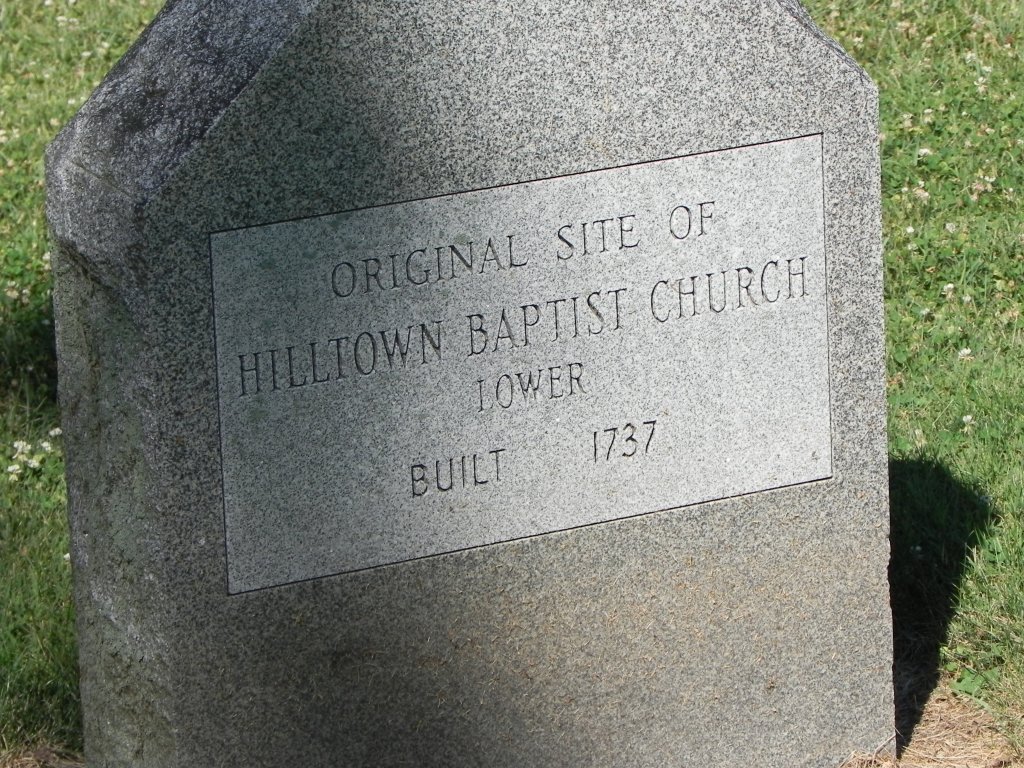
The property where the lower meetinghouses once stood is now marked with a stone. Along the road stands an enormous oak tree, christened a “Penn Oak” because it stood when William Penn came to an agreement with the local Indians in 1682. In 1932, the tree was believed to be 250 years old, and in 1982 its diameter measured 15 feet, 14 inches.
The Penn Oak stands along the road
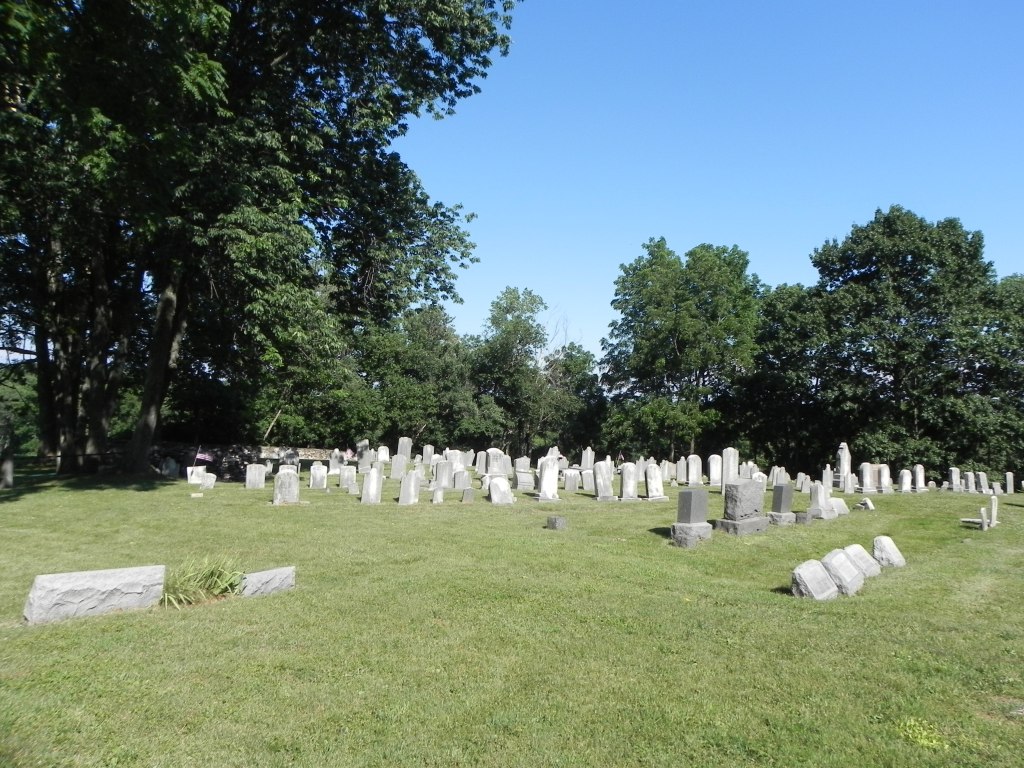
The large cemetery of the lower meetinghouse also remains, partially surrounded and shaded by trees, itself a testament to the centuries that have passed since William first set aside this land for the church. The oldest gravestones are made of plain shale or have been lost to the passing of time and the elements. It is believed that some graves are of Indians, as tradition says that some were friendly and would visit the cemetery to honor their ancestors.
This lower cemetery is the final resting place of William, his wife Ann, all seven of their children, and all their grandsons. Including William and his son, John, five Hilltown ministers and their wives are buried here. There are also graves of 22 soldiers, 15 of whom fought in the American Revolution. It is known that one soldier’s grave is unmarked. The cemetery is the final resting place of Benjamin Morris, a clockmaker and Bucks County sheriff, and Mathias Morris, who was a member of Congress in 1839. Also buried here is John Pugh, who was the recorder of deeds for Bucks County, served on the state legislature from 1800-1804, served in Congress from 1804-1808, was also a Justice of Peace. Some people have nine sets of grandparents in this one cemetery.
The “lower” cemetery, present day
A stone wall was built around the lower cemetery between 1812 and 1830. Though some stones were removed to make the foundation for the parsonage in 1895 (standing at the corner of Hilltown Pike and Chalfont Road), the wall remains.
The upper meetinghouse as it appears today, following the addition of a large new meeting hall, Sunday school classrooms, etc. Photo from 1982. (from “A Walk Down Memory Lane” p. 31)
John was born in December 1713, the first of William and Ann’s children born in America while his parents were still residing in Radnor. He married Sarah James, with whom he had four daughters: Anna, Rebecca, Leah, and Sarah. John was ordained in 1751 and gradually began taking over his father’s role as preacher at the lower meetinghouse, while also serving as pastor at the newly built upper meetinghouse. Upon the incorporation of the Hilltown Baptist Church in 1781, John became its first official pastor. John retired in 1789 after a stroke left him paralyzed, and he died on October 31, 1790. His wife, Sarah, died on April 2, 1805, having lived to be 94 years of age. Both are buried at the Hilltown Baptist lower cemetery.
Gravestone of John Thomas
Gravestone of Gwentlian (Thomas) Morris
Gravestone of Manasseh Thomas
Gwentlian was born in 1716. Her father preferred to call her “Gwently.” She married Morris Morris, son of Cadwallader Morris from Wales, and had nine children: Cadwallader, Abraham, William, Benjamin, Enoch, Joseph, Morris, and two others who died very young. Gwentlian died in April 1785. She is buried at the Hilltown Baptist lower cemetery.
Ephraim was born in 1719. He was a ruling elder of the Baptist church at Montgomery, and it is said that he had great abilities to console those who were grieving. He married Eleanor Bates in 1740 and they had eleven children: Enoch (who died young), Margaret, Elias, Dinah, Enoch, Rachel, Sarah, Elinor, Joseph, Ephraim, and John. Ephraim is said to have been, like the rest of his family, short and stocky with dark hair and eyes. He died on July 31, 1776, at the age of 57 – quite young when compared to his father and most of his brothers. This was attributed to his affliction by dyspepsia (chronic indigestion). Likewise, several of his children were weak and died young of illness. It has been noted that his daughters were very lively and bright, but often sickly.
Anna was born around 1719 – most likely late 1719 or early 1720 – and lived with her father until his death. She married Stephen Rowland (born in Wales in 1722) in August 1757 but died less than two years later on May 14, 1759, as was foretold by her father. She is buried in the Hilltown Baptist lower cemetery.
Gravestone of Anna (Thomas) Rowland
Manasseh was born in 1721 and Married Elizabeth Evans around 1750. They had three children: Eber, Amy, and Alice. Manasseh served in the American army in the Revolution, and it is said that he buried jars of money on his property to protect them from any British raids. In The Thomas Family of Hilltown, a story is recounted in which a Hilltown resident saw what he believed to be Manasseh’s ghost looking around behind the house he owned in life. The man who saw the apparition presumed that Manasseh was still guarding his buried treasure 100 years after his death, even though the jars had long since been recovered. Manasseh died on February 7, 1802 and is buried in the Hilltown Baptist lower cemetery.
William, the youngest of William and Ann’s children, was born in 1723. William Jr. married Abigail Day around 1750, and they had three children: William, Joseph, and Martha. Abigail was the only daughter of Joseph Day. It is said that as a child she was “evil and wayward” and that after her marriage to William she would attract “admiration and attention from other persons than was credible to a married woman” (The Thomas Family of Hilltown, p. 50). Sadly, William Jr. fulfilled his father’s prophecy that one of his sons would take to “intemperate ways” and meet a violent, premature death. The circumstances surrounding William Jr.’s death in July, 1764, are detailed in The Thomas Family of Hilltown:
“He was found dead one morning within the doorway of his house with a dark streak around his neck, as though strangled. The night had been dark and he had been away from home, drinking. It was strongly hinted and suspected that his death happened through foul means. An investigation took place. His wife was accused of the deed, or as being accessory, and tradition says she stood her trial at Newtown, but was acquitted for want of sufficient evidence”
(p. 50)
Since William Jr. had been willed the house that his father built and lived in, it can be presumed that this violent act took place at the oldest family homestead, built by Elder William almost 50 years before. William Jr. was buried in the Hilltown Baptist lower cemetery with his parents, brothers, and sisters. As for Abigail, she later remarried Philip Bitting, a German, with whom she had a family. Later in life she joined the Hilltown church and was buried in the Hilltown Baptist lower cemetery following her death in 1811. However, never satisfied with her acquittal, the Reverend Mathias who was the pastor at the time refused to officiate at her funeral or grave site.
Died: Nov. 29, 1941 (Buried at St. Mark’s Lutheran Church in Pennsburg)
Children: Margaret Alice, William, Russell
Alice Fox was born on October 1, 1884 and was baptized on November 16 of the same year. She and her husband, Philip V. Thomas, had three children:
Alice and one of her younger brothers (possibly Robert)
Margaret Alice (1910-1982)
William (1913-2007)
Russell (1916-2014)
(These children and their descendants are further discussed on the Thomas page)
Alice worked in at least two of the numerous cigar factories in Pennsburg: the J. J. Hillegass Cigar Box factory as well as a cigar factory on 4th Street in Pennsburg.
After the death of her husband, Alice became diabetic and remained at home. She was taken care of by her eldest daughter, Margaret, until Alice’s death on June 12, 1948. Both Philip and Alice are buried at St. Mark’s Lutheran Church Cemetery in Pennsburg.
Photos of Alice
Alice, far left, with other workers at the J.J. Hillegass Cigar Box factory
Alice is seated in the middle row, second from the right. This undated photo is captioned as being Alice and her classmates
Alice Fox’s ornate birth certificate is in German and calls much greater attention to the father than mother or child
Gravestone Photos
Gravestone of Alice and her husband, Philip Thomas, at St. Mark’s Lutheran in Pennsburg










 Leaves on the Tree